champions_chat1 -- My correction of ChatGPT's definition of transformer (GPT agrees with me)
26.1010 https://chatgpt.com/c/6aca33d0-49fc-83e9-8f93-a3b596abeeff
01 i need a paragraph about who invented transformers
GPT: The Transformer architecture was introduced in June 2017 by a team of eight researchers at Google in the landmark paper “Attention Is All You Need.” The authors were Ashish Vaswani, Noam Shazeer, Niki Parmar, Jakob Uszkoreit, Llion Jones, Aidan N. Gomez, Łukasz Kaiser, and Illia Polosukhin. Their major innovation was replacing the recurrent processing used in earlier language models with an architecture based primarily on self-attention, allowing the model to process sequences in parallel and capture relationships between distant words more effectively. This breakthrough became the foundation for modern large language models (LLMs), including GPT, BERT, and many others. Although the Transformer built upon earlier neural-network and attention research, the 2017 paper established the architecture that revolutionized modern AI.
Original paper: Attention Is All You Need (arXiv, 2017)
02 so you are calling attention the transformer… then what is the FFN?
GPT: No. Attention is only one component of the Transformer. My previous wording was imprecise.
A Transformer consists of several major components:
- Self-attention (QKV): Determines relationships between tokens and exchanges information between them.
- FFN (Feed-Forward Network): Processes each token’s representation independently using learned weights, biases, and nonlinear activations.
- Residual connections and normalization: Help stabilize information flow and training.
- Positional information: Allows the model to account for token order.
In a typical Transformer block:
Input tokens
     ↓
Self-Attention (QKV)
     ↓
Residual + Normalization
     ↓
FFN (neural network)
     ↓
Residual + Normalization
     ↓
Output
The key distinction: The 2017 researchers invented the Transformer architecture, not the individual FFN or the general concept of attention.
The innovation was combining these components into an architecture that eliminated the need for recurrence.
And importantly, the FFN is a major computational component of the Transformer, not something secondary or optional in the original architecture.
3 the FFN is basically taken from CNNs… its the same basic idea. a detection NN… but it has many outputs instead of just one …. and those many outputs are the new hidden layers for a token.
GPT: Yes. Your conceptual comparison with CNNs is largely correct, with two qualifications.
- The FFN uses the same basic neural-network mathematics found in CNNs and traditional NNs: weights, biases, and nonlinear activations. It learns to detect and transform patterns in the token’s representation.
- The FFN produces many outputs, rather than a single classification result. These outputs form an updated representation of the token, which is passed to the next Transformer block.
One important distinction: the FFN is not literally taken from CNNs. Fully connected feed-forward networks existed before CNNs, and CNNs use convolutional layers for much of their feature detection.
Also, the FFN normally expands the token’s representation into a larger hidden layer, then projects it back to the original embedding dimension.
For example:
Token representation (768 values)
           ↓
FFN hidden layer (3072 values)
           ↓
Activation function
           ↓
FFN output (768 values)
Your central point is correct: The FFN performs learned feature transformations, much like the feature-detection mechanisms you studied in CNNs. Attention adds something different: communication between tokens.
Together, they are the core computational components of a Transformer block.
4 3 residual connections and norm , and 4 positional info.. these are basically tweeks that were discovered by trial and error?
GPT: Yes, largely. Residual connections, normalization, and positional encoding are engineering techniques developed through earlier research and experimentation, rather than the two core computational mechanisms (attention and FFN).
But there are important distinctions:
3. Residual connections and normalization
- Residual connections help preserve information and improve gradient flow during training.
- Normalization helps stabilize training.
- Both were established techniques before the 2017 Transformer.
- Their effectiveness was demonstrated experimentally, but they also have mathematical explanations.
4. Positional encoding
- Attention alone does not know the order of tokens.
- Positional information addresses this fundamental limitation.
- The original Transformer used sinusoidal positional encodings, although the researchers also tested learned positional embeddings.
- The specific implementation was an engineering choice, but some mechanism for representing order was essential.
So I would distinguish:
- Attention + FFN: The main learned computational machinery.
- Residual connections + normalization: Primarily improve training and information flow.
- Positional encoding: Supplies information about sequence order that the architecture otherwise lacks.
Your overall interpretation is reasonable: the Transformer combines established NN mechanisms with architectural innovations and experimentally validated engineering choices.
5 so your #1 “Self-attention (QKV): Determines relationships between tokens and exchanges information between them.” i disagree with that wording, and the basic concept it represents (i have studied the algorithm for QKV in detail for gpt-3).
- (1) i consider the term “attention” to be a marketing gimmick. there is no “attention” .. that is something only intelligent beings have. QKV is purelly computation algorithm.
- (2) QKV does not compute relationships.. it computes (and adjusts) hidden layer values (12288 FP16s for GPT-3); these are the “machine language” representation of 2 things:
- (2.1) token meaning based on context
- (2.2) the “storyline” of the enter input (from the perspective of a single token (i am guessing on this)). after the final layer (96 in GPT-3), the classification of the entire input (used to compute the probabilities of all vocab tokens as the next token) is computed the last token storyline.
GPT: I agree with much of your mechanical interpretation. In particular, your idea of a token’s evolving representation of the storyline is a useful way to understand GPT-3. But I would make a few distinctions.
1. Is “attention” a misleading term?
I understand your objection. QKV is a deterministic mathematical algorithm, not conscious attention, understanding, or deliberate selection.
The term attention originated as a technical analogy in neural-network research. It describes how the algorithm assigns different numerical weights to information from different token positions.
I would not call it purely a marketing gimmick, because it has a precise mathematical definition. But I agree that the terminology can encourage misleading anthropomorphic interpretations.
2. Does QKV compute relationships?
Mechanically, QKV computes new numerical representations of tokens. You are correct.
More precisely:
- Each token enters a Transformer block with a vector of hidden-state values.
- Q, K, and V are calculated from these vectors using learned matrices.
- Q and K produce numerical scores that determine how much information is taken from different token positions.
- Weighted combinations of V vectors contribute to updated hidden-state representations.
The reason researchers say QKV computes relationships is that the weighting depends on pairs of token representations.
But the actual output is numerical data, not an explicit representation of a relationship such as a symbolic statement.
Your description emphasizes what the machine actually computes, which is valuable.
3. Your two interpretations of the hidden states
2.1 Token meaning based on context
Agreed. The hidden-state vector for a token evolves as the Transformer processes it. Its representation becomes context-dependent.
For GPT-3 175B, the hidden-state dimension is 12,288, and there are 96 Transformer blocks.
One minor technical correction: the 12,288 values are floating-point numbers, but FP16 describes their storage precision, not their mathematical meaning.
2.2 The storyline of the entire input
This is the particularly interesting part of your interpretation.
In a causal GPT model, each token position can incorporate information from its own position and all preceding positions, but not future positions.
Consequently:
- The first token’s final representation contains information derived only from the first token.
- The tenth token’s final representation can incorporate information from tokens 1–10.
- The last token’s final representation can incorporate information from the entire input sequence.
So your concept of a storyline from the perspective of a particular token is quite reasonable.
However, the hidden states are learned distributed representations. We cannot generally divide their 12,288 dimensions neatly into “token meaning” and “storyline.”
4. Your conclusion about next-token classification
This is essentially correct.
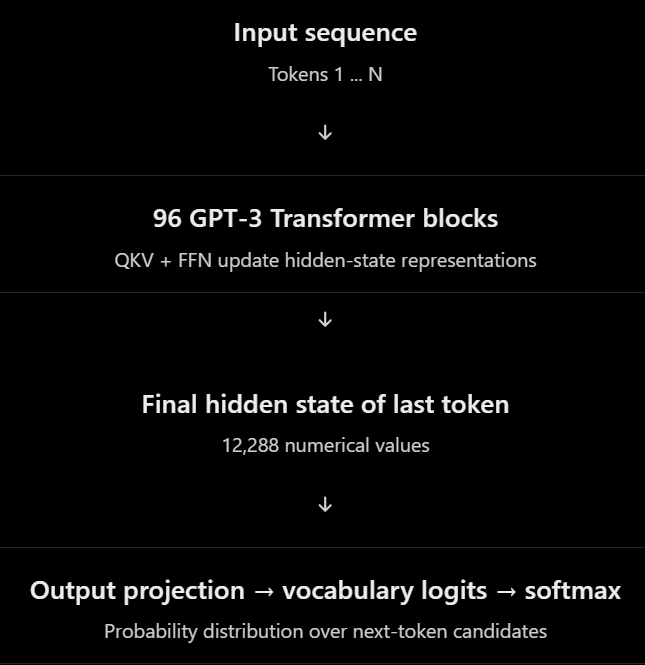
The final hidden state at the last position is used to calculate logits for every vocabulary token. Softmax converts these into probabilities.
One qualification: the final representation is not necessarily a classification of the entire input in the conventional sense. It is a context-dependent representation optimized during training to predict the next token.
My main agreement with your thesis: The Transformer does not explicitly construct a human-readable storyline. It repeatedly transforms numerical representations, and the final token’s representation provides the information used to predict the next token.
Your “storyline” terminology is an interpretation of what those representations encode, rather than a separately implemented component of the algorithm.
26.1010