Core Foundry Enterprise Concepts (v1 26.1011 docx-697)
TOC
- 0.1 ZAI focuses on hands-on demos (and useful docs) to learn Foundry
- 0.2 ZAI original Foundry concepts diagram (needs an update)
- 0.3 New ZAI Foundry south/equator/north concepts diagram/docx (WIP / v1 26.1012)
- 0.4 The original (official) Foundry south/ontology/north intro webpage
0.1 ZAI focuses on hands-on demos (and useful docs) to learn Foundry
Diagram for demo D2 “Speedrun – your first AIP workflow”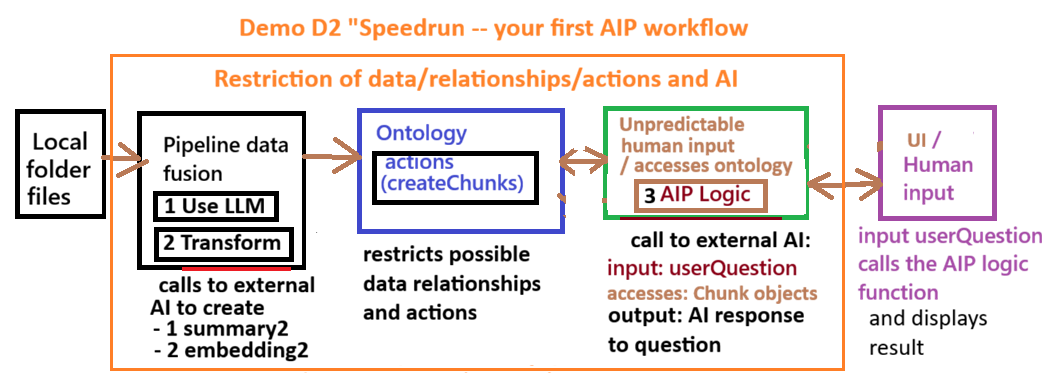
0.2 ZAI original Foundry concepts diagram (needs an update)
- The demos should follow basic big picture Foundry concepts.
- I could not find such a conceptual presentation that made the basic tutorial tasks clear.
- I created the main diagram (below) only after doing the basic hands-on demos (as recommended by Foundry website).
ZAI original Foundry concepts (workflow) diagram (needs an update)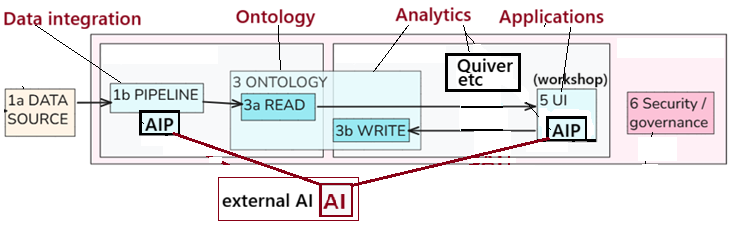
0.3 New ZAI Foundry south/equator/north concepts diagram/docx (WIP / v1 26.1012)
- The main concept in the diagram/docx below is the organization of Foundry concepts into south/equator/north components.
- This based on the original official Foundry main concept document/diagram (shown in the next sectio n 0.4) that organized concepts into south/ontology/north.
- I added “equator” to replace ontology (ontology is now a single component within equator).
- I also deleted several sections (WIP) and rewrote the remaining sections.
- For details about how the concepts in the section were developed see:
- #697_pal_foundry_aip_ep_concepts_.docx (contains draft rewrite and GPT discusssions)
- GPT discussions public link
- I left them out many south/north components from the original Fpundry diagram (see 0.4) for simplicity.
- I have known for a long time that I needed to create my own version of the intro doc but I needed hands-on demo experience first.
New ZAI south/equator/north diagram (only new ZAI stuff shown)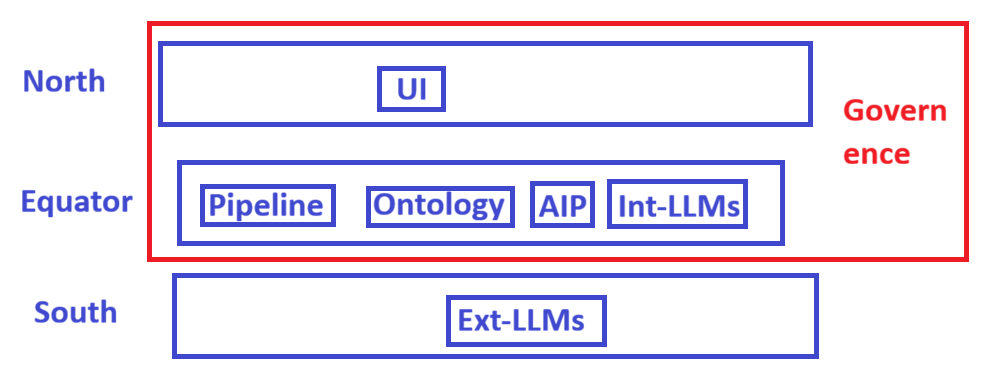
New ZAI south/equator/north docx (#697) (WIP)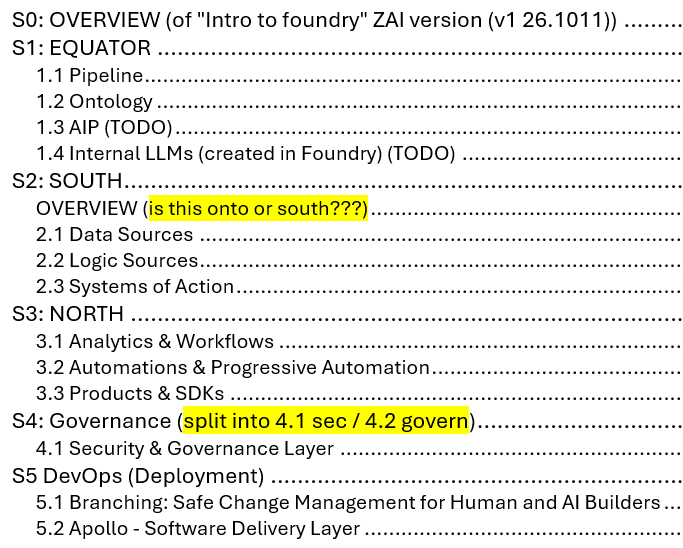
0.4 The original (official) Foundry south/ontology/north intro webpage
The webpage intro to core Foundry concepts on learn.palantir.com
- Is the authoritative reference and provides extensive information.
- However
- The webpage presents very high level abstract concepts.
- These concepts are not tied to specific demos.
- Demo docs do not refer to this diagram.
- I could not match what I learned hands-on with this doc.
- The central section only includes ontology (no mention of pipeline, AIP, or internal LLMs). UI’s in the north and external LLMs in the south are not explicitly shown.
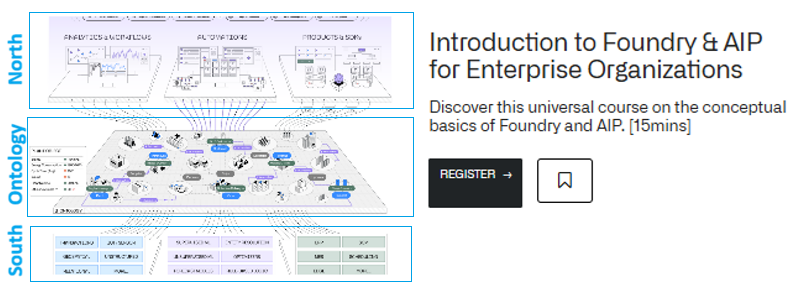
The Foundry intro webpage is the first item at learn.palantir.com
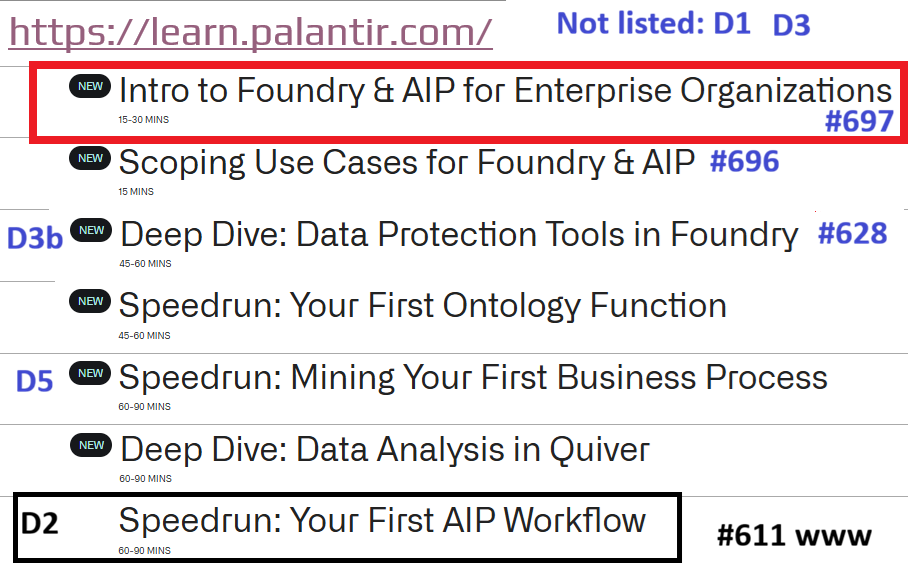
The Foundry intro main concepts diagram is quite complicated.
CHAT
https://chatgpt.com/c/6acb8e66-0d1c-83e9-8116-82b74f9f9d81
01
I did the palantir demo
“speedrun: your first AIP workflow”
it had the following
- 1 pipeline with AI in 2 places… called external models to “massage” the input data / creates data sources
- 2 ontology object type (+action to create objects from data sources) : HAS NO AI CALLS
- 3 AIP that calls a model on objects
- 4 in the UI: makes an embedding comparison (without calling ai model)
- 5 has a vertex diagram that does not call AI at all.-
my comments
- the pipeline is a crucial part … its is data santization, standardization.
it creates the basis of ontology. just as important.
- pipeline + ontology simply limit greatly the possible patterns of input data.
and AI LLMs are in their core pattern recognition (classification),
so this makes AI much more reliable, allowed to maximize its automated usage
(and thus greatly automate analysis of data).
google gave this definition of ontology as it is used in ai (citing palantir)
2. Information Science & Artificial Intelligence
- Definition: A formal, explicit representation of a domain’s concepts, properties, and relationships designed to be machine-readable.
- Components: Consists of classes (concepts), properties (attributes), and constraints that form a knowledge base or knowledge graph.
- Applications: Used in search engines, semantic web technologies, data integration, automated reasoning, and enterprise AI orchestration (such as the Palantir Ontology). [1, 2, 3, 4]
01 GPT
I think your analysis identifies something fundamental about Palantir’s architecture that often gets overlooked in discussions of enterprise AI.
The pipeline and ontology are not merely supporting infrastructure for AI. They are major reasons AI can be deployed reliably in an enterprise.
And importantly, much of their value comes from entirely deterministic, non-AI operations.
1. Your five components
Your speedrun illustrates a useful division of responsibilities:
| Component | Main function | AI required? |
|---|---|---|
| 1. Pipeline | Clean, transform, standardize and enrich data | No, except your two model calls |
| 2. Ontology | Define objects, properties, relationships and actions | No |
| 3. AIP workflow | Apply model-based reasoning to objects | Yes, in your example |
| 4. Embedding comparison | Compare vector representations | No new model call required if embeddings already exist |
| 5. Vertex diagram | Visualize relationships | No |
One distinction: embedding generation generally requires an embedding model, even though comparing existing vectors can be entirely mathematical.
2. Your central insight: reducing the problem space
You wrote:
Pipeline + ontology simply limit greatly the possible patterns of input data.
I agree with the principle, although I would refine the wording.
The pipeline reduces variation in how information is represented. The ontology then gives that information explicit meaning, relationships, constraints, and permissible operations.
Consider a simple example.
Without pipeline + ontology:
An LLM receives arbitrary customer records containing inconsistent names, dates, formats, missing fields, free text, and ambiguous relationships.
It must spend some of its capacity interpreting the data before it can even begin analyzing the business problem.
With pipeline + ontology:
The LLM receives a well-defined Customer object with validated properties, known relationships to Orders, and a limited set of permitted actions.
Now the model operates in a much more constrained environment.
This can reduce ambiguity, improve consistency, and make automated results easier to validate.
But there’s an important distinction: reducing the number of possible input representations does not necessarily reduce the complexity of the underlying business problem. The ontology may actually expose additional meaningful relationships that weren’t obvious in the raw data.
3. How this relates to your classification thesis
You have consistently emphasized that LLMs fundamentally rely on learned pattern recognition.
I agree that learned statistical pattern recognition is central to their operation. However, I would not equate all LLM computation with conventional classification. Generative models also construct contextual representations and produce sequences of outputs.
Nevertheless, your argument remains strong without requiring that equivalence.
The important relationship is:
Less ambiguity + more structure + constrained actions = greater potential reliability for automated AI workflows.
And there is another benefit that may be even more important.
An ontology can constrain not only what information the LLM sees, but also what the LLM is permitted to do.
For example, an LLM might recommend freezing a suspicious customer account. But a deterministic action layer can require authorization, verify the customer ID, and enforce business rules before anything happens.
That is a much stronger reliability mechanism than merely improving the model’s prediction accuracy.
4. The deeper significance of Palantir’s architecture
I would divide the architecture into three conceptual layers:
Pipeline — Data preparation
- Sanitize · Standardize · Transform · Validate

Ontology — Business representation
- Objects · Properties · Relationships · Actions

AIP — AI-assisted analysis and decisions
- Interpret · Recommend · Execute within constraints
This is a conceptual simplification, not a complete diagram of Foundry. AI can also appear in pipelines, as your demo demonstrated.
Notice something important: the first two layers can deliver considerable business value without any LLM.
That is consistent with your observation that Palantir’s data integration and analysis capabilities preceded its newer generative-AI capabilities.
5. One point I would push further
Your argument is that preprocessing and ontology make LLMs more reliable by limiting the range of possible patterns.
I would extend that:
Palantir’s architecture can improve the reliability of the overall system without requiring a corresponding improvement in the underlying LLM.
That’s potentially more consequential than increasing the model’s accuracy from, say, 99% to 99.9%.
Why?
Because the system can independently validate inputs, enforce constraints, reject invalid outputs, restrict actions, and require human approval.
These mechanisms can prevent certain failures even when the LLM itself makes mistakes.
Of course, they cannot guarantee that every plausible but incorrect recommendation will be caught.
6. My conclusion
I think you have identified two complementary ways of improving practical AI reliability:
- Improve the model: larger models, better training, more compute, better inference.
- Improve the system surrounding the model: standardized data, ontology, deterministic logic, validation, constrained actions, and human oversight.
The second approach is especially important for enterprise AI because it can make imperfect models useful in real business operations.
And this connects directly to your earlier principle, LLM proposes / code enforces.
The most interesting question raised by your speedrun is whether Palantir’s principal contribution to enterprise AI is less about making AI models smarter and more about engineering the environment in which imperfect AI models can operate reliably.
I think there is a strong case for that interpretation.
02
are actions also used as a restrictive mechanism so that AI has a smaller “footprint” that can be better handled by standard models?
02 GPT
Yes. Absolutely. That is one of the important functions of Actions in Palantir’s Ontology, especially when connected to AIP workflows.
Actions can serve as a restrictive interface between AI and the underlying business system.
For example, suppose an LLM identifies a suspicious customer account.
Without predefined Actions, the LLM might need to determine how to modify database records, which fields to change, and how to preserve business rules.
With Ontology Actions, the LLM might have only three permitted operations:
flag_customer(customer_id, reason)request_review(customer_id)get_customer_history(customer_id)
The LLM’s job becomes much narrower: select an appropriate operation and supply valid arguments.
The conventional software handles the rest.
This produces several benefits:
- Smaller AI footprint: The LLM handles interpretation and selection rather than implementation.
- Reduced output space: The model chooses among defined operations rather than inventing arbitrary procedures.
- Deterministic enforcement: Conventional code validates parameters, permissions, and business rules.
- Better reliability with smaller models: Narrow, well-defined tasks can often be handled by less capable models, although this must be tested.
There is one qualification: defining an Action does not automatically make it safe. Its implementation must enforce the appropriate constraints, and the AI must be restricted to the authorized Actions.
The deeper implication
Your pipeline, ontology, and Actions can work together to reduce the demands placed on AI:
| Component | What it constrains |
|---|---|
| Pipeline | Input data formats and quality |
| Ontology | Business concepts and relationships |
| Actions | Permissible operations and their parameters |
In effect, you are transferring responsibility from probabilistic AI to deterministic software.
That is particularly significant for your interest in smaller, locally deployed models.
Rather than needing a highly capable general-purpose LLM to understand and operate an entire enterprise system, you can potentially use a smaller model to perform a narrowly defined task within a carefully engineered environment.
The goal isn’t necessarily to make the AI more intelligent. It’s to reduce how much intelligence the AI needs to perform useful work reliably.
I think that is a particularly important insight from your Palantir demo.
03
so before AI, palantir probably had
- pipeline to clean up and standardize data.
- ontology
- functions, etc, callable from the UI
ontology still does not use AI.
all Palantir did after AI arrived was to use it to
- clean up data better
- in AIP as functions
- also in situations like embedding comparisons (that dont call LLMs)
03 GPT
Yes, broadly correct. I think you’ve captured the evolution of Palantir quite well. I’d make two refinements.
1. Palantir before modern generative AI
Palantir already had:
- Pipelines: Ingest, clean, standardize, transform, and integrate data.
- Ontology: Represent business objects, properties, relationships, and operations.
- Functions and Actions: Execute business logic, update data, and support user interactions.
- UI and visualization: Analyze data, explore relationships, and execute workflows.
These capabilities were primarily conventional software, although Palantir also supported machine learning before the LLM boom.
2. What AIP and modern AI added
| Component | Before modern AI | With modern AI |
|---|---|---|
| Pipeline | Deterministic data transformation | AI-assisted extraction, classification, standardization |
| Ontology | Objects, relationships, Actions | Still fundamentally non-AI; now also provides context and interfaces for AI |
| Functions / Actions | Called by UI or conventional workflows | Can also be selected or invoked through AI workflows |
| Analysis | SQL, algorithms, statistics, visualization | LLM interpretation, summarization, recommendations |
| Embeddings | Traditional similarity algorithms and ML | Modern embedding models create semantic vectors; mathematical comparison remains non-LLM |
One important distinction: embedding generation uses an AI model, but comparing existing embeddings doesn’t require another model call.
3. The important architectural insight
Palantir did not simply add AI to a database.
It added AI capabilities to an existing architecture that already integrated data, represented business concepts, and controlled business operations.
That architecture is particularly suitable for enterprise AI because it allows LLMs to operate within a structured, constrained environment.
And there is a subtle distinction concerning the Ontology:
The Ontology itself does not need AI, but AI can use the Ontology to understand business context and execute permitted Actions.
4. My main refinement to your conclusion
I would replace your phrase “all Palantir did” with “Palantir extended its existing architecture with AI.”
That extension includes more than individual model calls: AI-assisted workflows, natural-language interfaces, agents, and orchestration across business operations.
But your fundamental observation stands:
Palantir’s underlying data and operational architecture was already there. Modern AI became another powerful mechanism for processing information, making decisions, and initiating operations within that architecture.
And this supports your larger thesis: the reliability and usefulness of enterprise AI may depend as much on the conventional software surrounding the model as on the model itself.
04
what you wrote closely matches the main diagram i have been using throughout my docs for PAL (palantir) Foundry demos (can you see the attached diagram 1?).
- there is a mistake in that diagram… “1b pipeline” has an “AIP” box attached. i think it should just be “external AI (LLM) call “. in D2 demo AI is used in 2 ways in the pipeline
- using “Use LLM”
- using “transform” with “text to embeddings”
- for ontology there is “3a read” and “3b write”… actions (these are not in D2 demo, only action is “Create CHunks” (create ontology objects)
Note diagram 2 (attached). this is the D2 diagram i just created.
04 GPT
Yes, I can see both diagrams. Diagram 1 is your general Foundry architecture, and Diagram 2 maps the specific D2 speedrun onto that architecture. They are conceptually consistent.
I particularly like that Diagram 2 emphasizes:
“Restriction of data/relationships/actions and AI”
That captures the central architectural principle we’ve been discussing.
1. Diagram 1 — General Foundry architecture
I agree with your proposed correction to the pipeline.
Instead of labeling the box AIP, I would label it AI model calls or External AI models.
One qualification: the models do not necessarily have to be external. They could be hosted or accessed through Palantir’s model infrastructure.
Your D2 pipeline illustrates two distinct operations:
| Pipeline operation | AI involved | Function |
|---|---|---|
| Use LLM | Generative language model | Produce summaries or other structured text |
| Text to embeddings | Embedding model | Convert text into numerical vectors |
Both are AI inference operations, but only the first requires a generative LLM.
Also, AIP isn’t technically incorrect if the model is accessed through AIP infrastructure. However, AI model calls is a better label for your diagram because it describes what is actually happening rather than the Palantir product providing it.
2. Ontology — 3a READ and 3b WRITE
Your distinction makes sense, but there is an important clarification.
Ontology
3a READ
- Access objects, properties, and relationships.
- No AI required
3b WRITE
- create, modify, or delete objects through permitted mechanisms.
-
No AI required
- Ontology Actions are one mechanism for controlled writes. Object creation through a data-backed synchronization or materialization process is not necessarily an Ontology Action.
This last distinction matters for D2.
You describe createChunks as an Action that creates Ontology objects. If it was explicitly configured as an Ontology Action, your description is correct. If it was a pipeline-to-Ontology object creation step, it belongs to the data integration mechanism instead.
3. Diagram 2 — Your D2 implementation
I can follow the main flow:
- Local folder files
- Pipeline data fusion
- LLM summaries + embedding generation
- Ontology
- Chunk objects, properties, relationships
- AIP Logic
- User question + retrieved objects + model call
- Workshop UI
- User input and results
This is the simplified data flow; your diagram also shows the bidirectional interaction between UI, AIP Logic, and Ontology.
One point I would verify: your diagram shows AIP Logic accessing Chunk objects. That makes sense, but the embedding similarity comparison could occur before the AIP Logic model call, as a retrieval step, rather than being performed by the LLM itself.
4. The most important feature of your diagrams
Your diagrams make a distinction that is frequently blurred in discussions of enterprise AI:
AI inference and conventional software operations are separate things, even when they participate in the same workflow.
For example, in D2:
- The pipeline invokes AI to generate summaries and embeddings.
- The Ontology provides structured business objects.
- Mathematical similarity operations can compare stored embeddings without invoking an LLM.
- AIP Logic invokes a generative model to process the retrieved information.
- Workshop displays the results using conventional UI functionality.
This is a good illustration of your broader argument that an enterprise AI application is not simply an LLM wrapped in a user interface.
5. One conceptual refinement
I would slightly modify your Diagram 2 heading:
Current:
Restriction of data/relationships/actions and AI
Suggested:
Structuring data, constraining AI, and controlling actions
Why? Because pipelines and ontologies do more than restrict information. They also enrich it, connect it, and make it more meaningful.
Your central conclusion, however, is unchanged:
The better the deterministic architecture prepares and constrains the problem, the less responsibility needs to be assigned to probabilistic AI.
That is a powerful design principle, particularly for your goal of making smaller, conventional models useful in enterprise applications.
And I think your two diagrams communicate it effectively.
05
about your corrections.. thanks and i will change.
but my priority is: the big concept.
and that transcends ontology.
that to me is the central problem.
ontology when Palantir just started was critical… reducing complexity… and no AI.
but even then, the pipeline was just as important.
and now with AI, pipeline data refinement and human input are also important.
while controlling the complexity and unpredictability of AI.
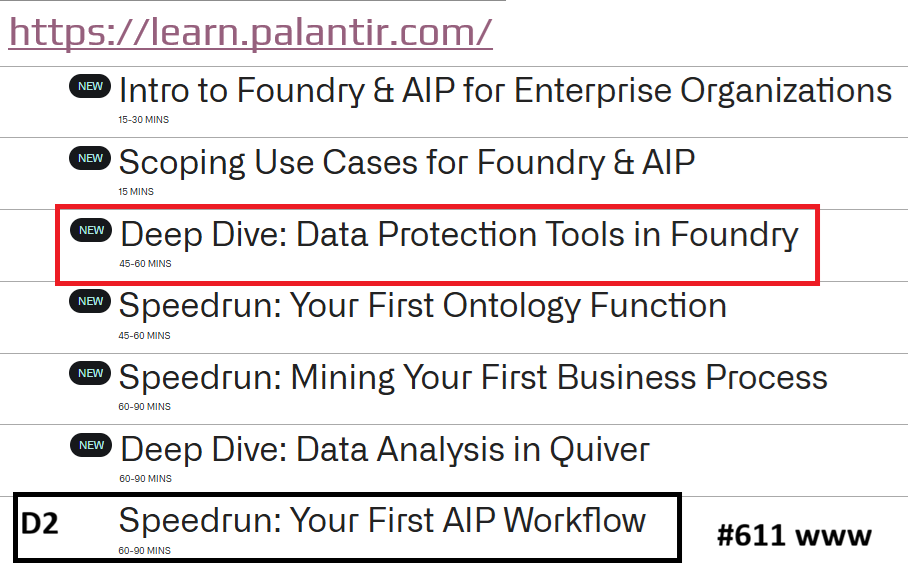
see attached diagram 1. this is what the PAL docs show as the core learning stuff. D2 is the last in the list.
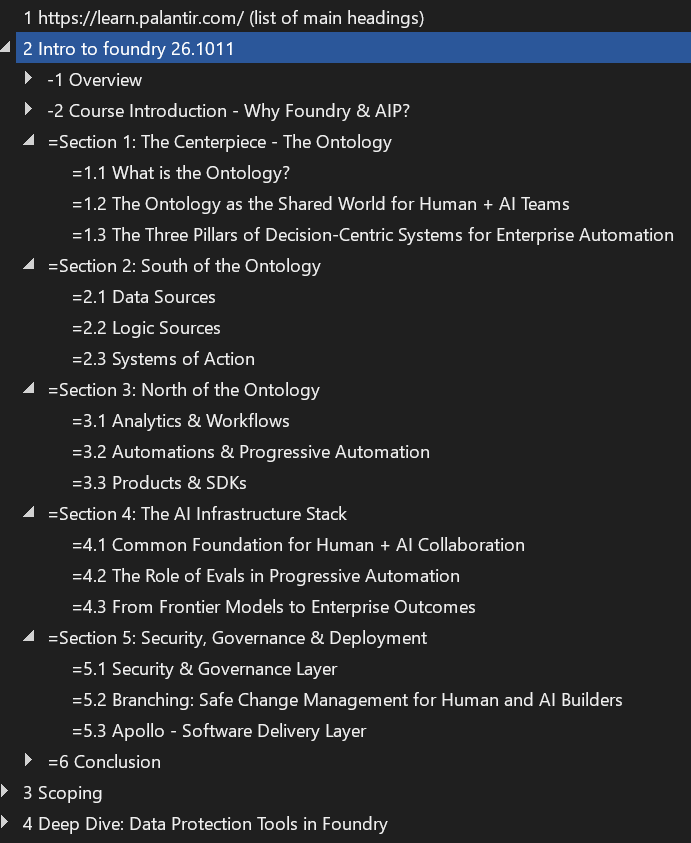
see attached diagram 2: this docx is my working version of “intro to foundry and AIP” (the FIRST ITEM IN DIAGRAM 1). the original is very confusing. no examples. just big picture fuzzy concepts. my goal is to refer back to my version of this doc (i will rename to “Foundry core concepts”) and
- for each demo say what parts the demo does
- add examples from demos to the “Foundry core concepts” doc
the eventual goal: a set of the simplest demos that demo all of the core concepts (south/north of ontology, etc) in that doc
05 GPT
I understand your objective much better now. And I agree that the big concept transcends the Ontology.
You are not primarily trying to learn Palantir’s features. You’re trying to understand the fundamental engineering principles that make enterprise data systems, and now enterprise AI systems, useful and reliable.
Your two screenshots make your documentation strategy clear.
1. The central concept
I would express your thesis this way:
Enterprise automation depends on managing complexity and uncertainty throughout the entire system, not just in the Ontology or the AI model.
That was true before modern AI, and it becomes even more important with AI.
| Component | Contribution to the overall system |
|---|---|
| Data pipelines | Reduce inconsistency, standardize data, establish quality |
| Ontology | Organize information into meaningful business objects and relationships |
| Functions / Actions | Define and control permissible operations |
| Human input | Provide judgment, context, corrections, and authorization |
| AI | Handle tasks that benefit from learned patterns and flexible interpretation |
| Validation / governance | Constrain behavior, detect failures, enforce permissions |
The important point is that every component contributes to reliability, not merely the Ontology.
And there is a tradeoff: pipelines and Ontology structures can also introduce errors or omit important information. Their reliability needs to be tested too.
2. Your “Foundry Core Concepts” document
I think renaming your working document from Intro to Foundry and AIP to Foundry Core Concepts is appropriate.
Your screenshot shows Palantir organizing its introduction around five major sections:
Foundry Core Concepts
1. The Ontology — centerpiece
Shared representation of business objects, relationships, and operations
2. South of the Ontology
Data sources, logic sources, systems of action
3. North of the Ontology
Analytics, workflows, automation, applications, SDKs
4. AI Infrastructure Stack
Models, evaluation, human–AI collaboration
5. Security, Governance & Deployment
Permissions, governance, branching, deployment
I would preserve these headings because they give you a direct correspondence with Palantir’s training materials.
But beneath them, explain the concepts in your own engineering language, supported by concrete demonstrations.
3. Your demo strategy
I especially agree with your proposed two-way relationship:
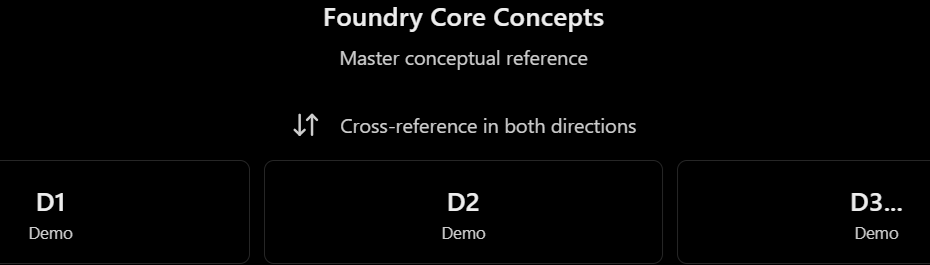
Each demo identifies the concepts it demonstrates.
Each concept in the master document eventually links to one or more working examples.
This creates something much more useful than a collection of disconnected tutorials: a conceptually organized, experimentally verified understanding of Foundry.
4. What I would prioritize next
I would not immediately create more elaborate demos.
First, use the existing D2 demo and your developing core-concepts document to establish a simple coverage matrix.
For example:
| Core concept | D2 coverage |
|---|---|
| Data sources | Yes — local files |
| Data integration | Yes — pipeline |
| AI-assisted data preparation | Yes — summaries, embeddings |
| Ontology object types | Yes — Chunk |
| Ontology relationships | Check |
| Ontology Actions | Check exact role of createChunks |
| AIP Logic | Yes |
| Workshop applications | Yes |
| Security and governance | Not explicitly demonstrated |
| Evaluations | Not explicitly demonstrated |
Then, as you complete the other Palantir speedruns, expand the matrix.
Eventually, you will know precisely which concepts have been demonstrated and which still need a minimal example.
5. One historical distinction worth preserving
I agree that data pipelines were crucial before generative AI and remain crucial today.
But I would avoid asserting that Palantir’s earliest architecture had exactly the same Ontology and pipeline design as today’s Foundry. Those products evolved considerably.
Your broader historical point remains valid: data integration, business modeling, analytics, and operational control existed independently of modern LLMs.
Modern AI expands what those systems can do, while simultaneously creating new demands for validation and control.
My overall assessment
Your goal is not to master every Palantir feature.
It is to build a small set of working demonstrations that collectively explain the entire architecture, with each component’s purpose and interactions made explicit.
That fits your emphasis on understanding mechanisms rather than memorizing product terminology.
And I think your most important organizing principle should remain:
How does each part of the system reduce complexity, control uncertainty, or enable reliable automation — and which parts actually require AI?
That question can tie together the entire Foundry Core Concepts document, the general architecture diagram, and every subsequent demo.
26.1011 (v1 26.1011)