2.2x ZAI Foundry core demos -- Concepts
This page describes the concepts of the core 7/8 demos:
- C1 Workflow
- C2 Data protection
- C3/C6 AIP / agentic
- C4 (5b) Automation
See also
- 2.2b ZAI versions of the core ~8 Foundry getting started demos is currently (26.0914) the main focus of ZAI.
- Palantir concepts covers some of the higher level PAL concepts not in this secgtion (this section is about the concepts directly related to the demos).
- PAL demo strategy (outdated).
- Important info about doing these demos (outdated). The advantages of website tutorials over Youtube videos (at least for beginners) and the critical importance of FDE (Foundry’s built-in AI chat tool).
TOC
- C1) (1,3,4/5) Foundry Core workflow (no Automation) [1]
- C2) (6) Data protection [2]
- C3) (2) AIP / external AI (agentic 1 / Foundry = AIP or AI agent?)
- C4) (5b) Automation (agentic 2)
- C6) (2) AI internal (agentic 3; no ALPHA threat) [5]
C1) (1,3,4/5) Foundry Core workflow (no Automation)) [1]
The following diagram shows the basic PAL workflow.
- 1a Data source. Raw data from enterprise systems. For example: CSV files, Databases, ERP systems, CRM systems, Sensors, External APIs.
- 1b Pipeline. Transforms raw data into clean, structured, and consistent datasets. For example: cleaning, joining, filtering, aggregating, validation.
- 3a Ontology read. Applications and users read enterprise data through the ontology. The ontology provides a common operational model of the enterprise.
- 3b Ontology writeback. Applications, workflows, and users update enterprise systems through the ontology. For example: change status, create ticket, approve request, update record.
- 4 Analysis. Code, queries, dashboards, rules, AI, and other logic analyze the ontology data. Purpose: discover information, detect problems, and support decisions.
- 5 UI / App. User-facing applications. For example: dashboards, workflows, forms, operational applications, AI assistants.
- 6 Security / Governance. Controls who can see data, modify data, run workflows, and use AI. For example: permissions, auditing, approvals, version control, lineage, logging, AI.
- About AI. AI can appear in many layers: pipeline transforms, model integration, ontology functions, analysis, UI assistants, and governance monitoring. AI should be treated as a helpful assistant, not the center of the system and not the final authority. The responsible pattern is: AI suggests, deterministic logic verifies where possible, humans approve important actions, and the platform logs and governs the workflow.
USE THIS?? Foundry enterprise platform functionality”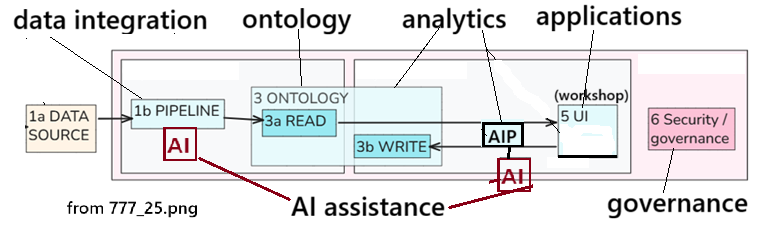
The ontology is the operational heart of Foundry. Most applications, analysis, workflows, and AI interact with enterprise data through the ontology rather than directly through the raw datasets.
The three crystal balls represent three layers of governance. Foundry controls
- Crystal ball #1 — Data governance. Controls how raw enterprise data becomes trusted operational data.
- Examples: ingestion, transformation, validation, lineage.
- This is the boundary between: Data Source, Pipeline, Ontology.
- Crystal ball #2 — Operational governance. Controls how applications, users, workflows, and AI interact with the enterprise.
- Examples: ontology permissions, workflow permissions, write-back controls, approval processes.
- This is the boundary around: Ontology, Analysis, UI, Writeback.
- Crystal ball #3 — Global governance. Controls the entire platform.
- Examples: security, auditing, version control, branching, deployment, compliance.
- This is the layer that sits above everything else.
Foundry’s core value proposition predates generative AI. It integrates data from different systems, represents entities and relationships through the Ontology, and helps users discover patterns, anomalies, connections, and business processes that are difficult to see in isolated datasets (finding “needles in the haystack”). In these demos, the LLM is an optional analytical assistant; the underlying data integration, Ontology, analysis, applications, and Actions remain useful without it.
(1,3,4/5) Core workflow (no Automation))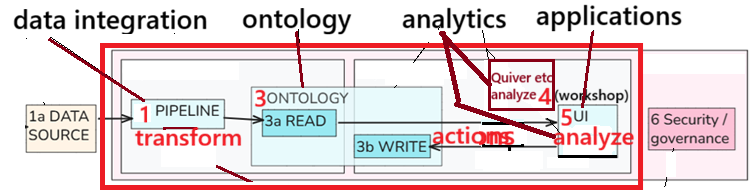
PAL concepts of Foundry main capabilities
This diagram shows the original PAL conceptualization of Foundry’s main capabilities (NOTE that 5b Automation does not appear in this diagram!) – ZAI takes a much different approach (Pic from palantir.com/docs/foundry)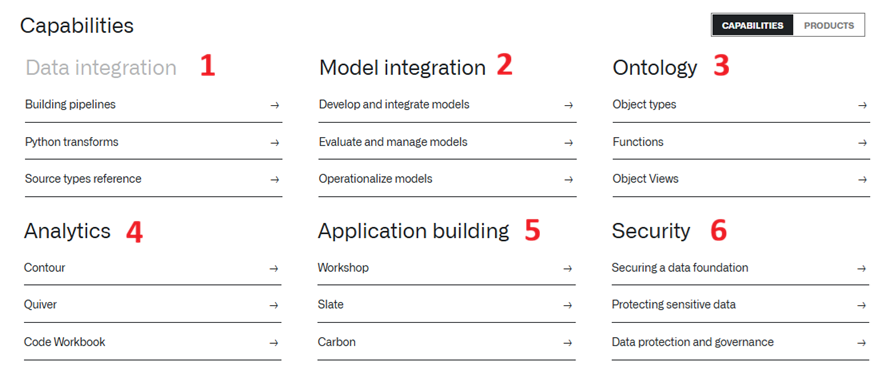
C2) (6) Data protection [2]
Data security = How do we prevent unauthorized access, disclosure, modification, or loss? Topics include:
- permissions and markings;
- sensitive-data scans;
- encryption;
- download controls;
- justification prompts;
- audit logs;
- prompt-data leakage;
- Action restrictions.
Data protection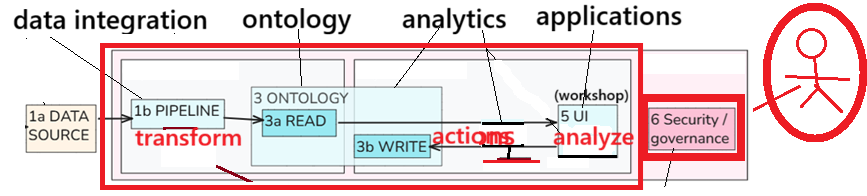
C3) (2) External AI using Foundry “AI Platform” (AIP = AI agent) (agentic 1)
- C3.1) External AI [3]. This is the first set of demos because external models are vastly simpler to use than creating/using internal models.
External AI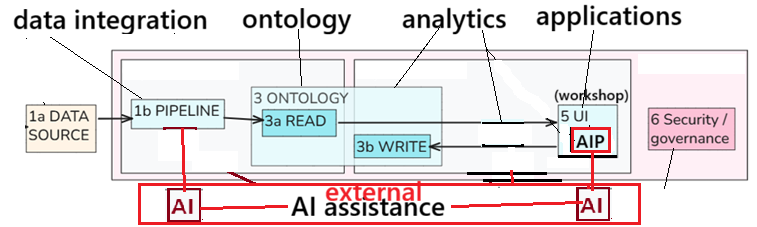
- C3.2) “Foundry AI Platform” = AI agent. The naming says it all:
- AIP suggests Foundry = ALPHA (this is the correct orientation; the business logic is more imporant that a token generator based on pattern matching).
- AI agent suggests AI = ALPHA (this is the AI/AGI super-duper-intelligence hype; it’s goal is to suggets that AI has some kind of intelligence (it does not; its a computing platform).
- C3.3) AIP can be used in different agent modes
- (4a) chat. The external AI is used to get text replies.
- (4b) action. The external AI is used to perform actions (such as modifying the ontology; this is especially risky).
4a = chat / 4b = action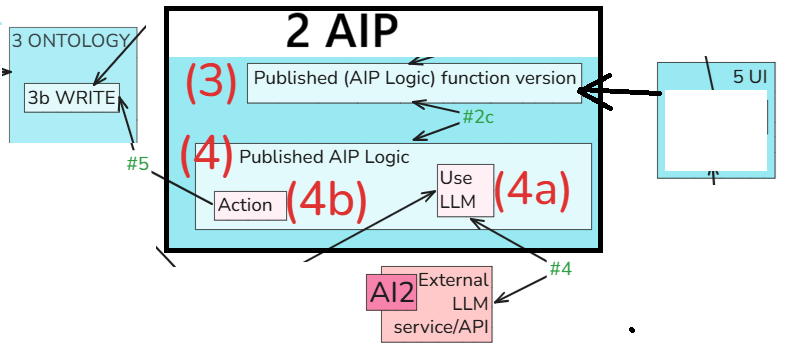
C4) (5b) AUTOMATION (agentic 2)
- chat: Risk of data leakage.
- action: Risk of data contamination.
5b = automation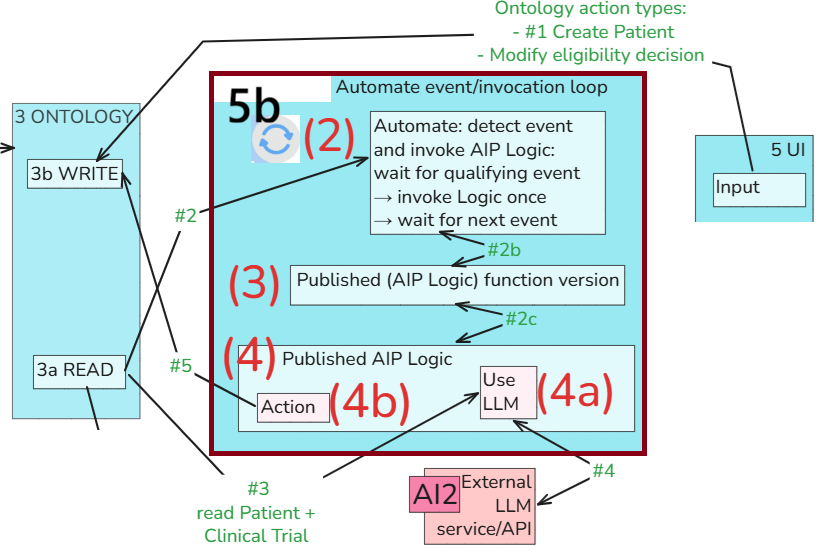
C6) (2) AI internal (agentic 3; no ALPHA threat) [5]. Demos that show how to create and host internal modelss.
xxx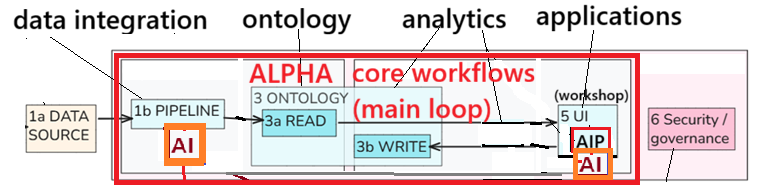
26.0915 (v1 26.0725)