2b Models
You control the model.
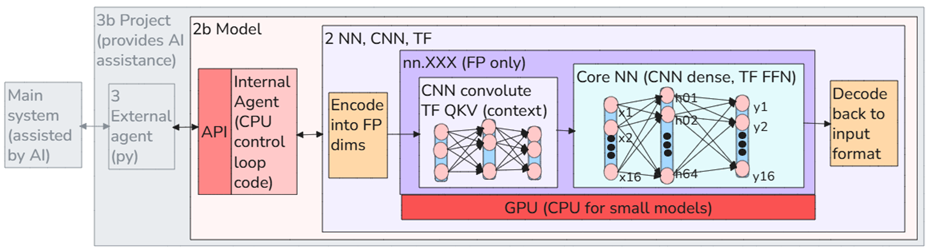
This WIP page (v1 26.0610) describes model internals. The agent and the NN are typically packed into a model that has an API that makes it possible for existing software to use the model as a “helpful” assistant. The internal agent (iAgent) that has been programmed to interact with the transformer (TF) via a very specific token-only protocol. The TF has also been trained to follow this protocol.
Eventually we all need to host our own models (and that becomes less difficult as time goes by)
2b Models in the master diagram
2b.1 Model concepts
(2b.1b 2025 demos)
- See wiki page “AI LLM stacks”.
2b.2 Tiny demos
- 2b.2.1 M01-M04 Define model, .pt load/save, run inference
- 2b.2.2 M05 Mismatch
- 2b.2.3 M06 Manual inference
- 2b.2.4 HF
- 2b.2.5 M07 API
- 2b.2.6 M08 Render (TODO)
- 2b.2.7 M09 Protocol / Tool Use
- 2b.2.8 M10 Trigger / Backdoor
2b.2b Building models
For specific domains. How do I create a model for a specific purpose?
Domain-specific models, Synthetic data, Custom TF, Custom CNN.
Datasets, Synthetic Data, Model Evaluation.
2b.3 Modifying models
Modifying/customizing/fine-tune. LoRA, Adapters, Domain Specialization
2b.4 Operating models
I already have a model. How do I operate it?
Examples: HuggingFace, Ollama, GGUF, Gemma, Llama, Qwen, Mistral.
This is:
- Acquire
- Deploy
- Run
- Use

NOTE:
HF is not necessarily local. For example:
  HF download → local.
  HF hosted inference → remote.
  Ollama → local.
  Open-weight model on cloud VM → remote.
The common theme is really:
  How do I obtain and operate a model?
not necessarily:
  How do I run it locally?
26.0616 (v1 26.0610)