3.3.8b pal_core_08 plan LLM
[3.3.8b] pal_core_08_plan.py + LLM (BINGO) 26.0424
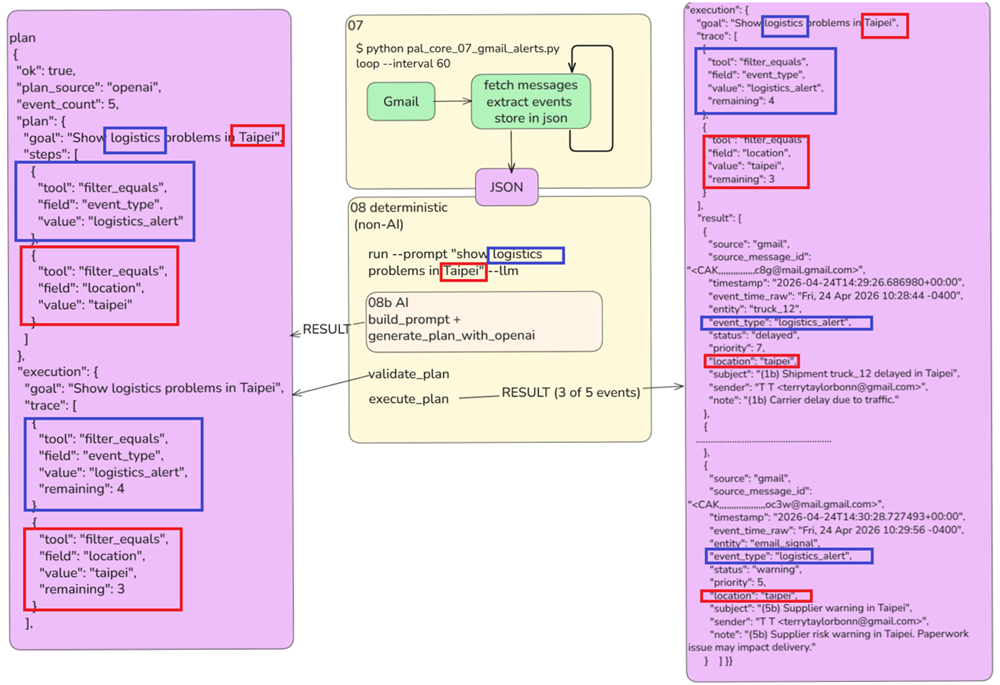
(1) fallback_plan(...)
Creates the plan directly with Python rules.
user text -> Python if/else -> plan dict
(2) build_prompt(...)
Only creates instructions for the LLM.
user text -> prompt text
It does not create the final plan by itself.
________________________________________
Full LLM Path
The real replacement for fallback_plan(...) is:

generate_plan_with_openai(...)

Inside that routine:

build_prompt(...)
-> send prompt to LLM
-> receive JSON
-> parse JSON
-> return plan

________________________________________
Correct Comparison
No LLM mode
fallback_plan()
LLM mode
generate_plan_with_openai()
    uses build_prompt()
________________________________________
Simple Mental Model
build_prompt() = instructions sheet
LLM = planner
generate_plan_with_openai() = whole LLM planning pipeline


#641 so execute_plan has no ai
Correct.
execute_plan() has no AI
It is ordinary deterministic Python logic.
It does things like:
•	filter rows
•	sort rows
•	limit rows
•	count groups
•	compare counts
Example
If plan says:
{"tool":"count_by","field":"status"}
execute_plan() calls:
op_count_by(rows, "status")
No model. No learning. No reasoning.
Architecture
Planner = optional AI
Executor = normal software
Why Important
This is the “AI on rails” pattern:
•	AI suggests plan
•	software performs trusted operations

#642 so you use AI to create a "sanitized" plan (a function somewhat like that of ontology) .. thats the core of this demo.
Exactly.
That is the core insight.
Core Pattern
Human request
-> AI translates intent
-> constrained / sanitized plan
-> deterministic system executes
Why “sanitized”
Because the raw human request is vague, messy, ambiguous.
The plan becomes:
•	structured
•	schema-bound
•	limited to allowed tools
•	limited to allowed fields
•	validated before execution
Why it resembles ontology
Yes — because it maps human language into approved machine concepts like:
•	status
•	location
•	priority
•	event_type
That is very similar to an ontology / semantic layer.
Your Demo in One Sentence
AI is not running the system. AI is converting language into safe machine actions.
# pal_core_08_plan.py
#
# 3.8 -- natural language -> plan JSON -> controlled execution
#
# Purpose:
#   Read PAL events from JSON, ask an LLM to produce a very small plan JSON,
#   validate that plan, then execute it deterministically.
#
# Demo goal:
#   Show that the LLM does NOT do the data processing directly.
#   The LLM only proposes a constrained plan.
#   Deterministic Python executes the plan.
#
# Environment variables:
#   OPENAI_API_KEY=...
#
# Optional:
#   PAL_EVENTS_FILE=pal_events07.json
#   PAL_OPENAI_MODEL=gpt-4.1-mini
#
# Commands:
#   python pal_core_08_plan.py reset_demo_data
#   python pal_core_08_plan.py show_events
#   python pal_core_08_plan.py run --prompt "Show delayed events in taipei"
#   python pal_core_08_plan.py run --prompt "Compare delayed vs blocked events"
#
# Notes:
#   - Input file must contain {"events":[...]}
#   - This file can read the output of pal_core_07_gmail_alerts.py
#   - If you do not want to use real 07 data yet, use reset_demo_data first

import argparse
import json
import os
import sys
from collections import Counter, defaultdict
from typing import Any, Dict, List, Tuple

try:
    from openai import OpenAI
except ImportError:
    OpenAI = None


# --------------------------------------------------
# 1. Config
# --------------------------------------------------

EVENTS_FILE = os.getenv("PAL_EVENTS_FILE", "pal_events07.json")
DEFAULT_MODEL = os.getenv("PAL_OPENAI_MODEL", "gpt-4.1-mini")


# --------------------------------------------------
# 2. JSON helpers
# --------------------------------------------------

def load_json(path: str, default: Any) -> Any:
    if not os.path.exists(path):
        return default
    with open(path, "r", encoding="utf-8") as f:
        return json.load(f)


def save_json(path: str, data: Any) -> None:
    with open(path, "w", encoding="utf-8") as f:
        json.dump(data, f, indent=2, ensure_ascii=False)


def load_events() -> List[Dict[str, Any]]:
    data = load_json(EVENTS_FILE, {"events": []})
    events = data.get("events", [])
    if not isinstance(events, list):
        raise ValueError(f"{EVENTS_FILE} must contain an 'events' list")
    return events


# --------------------------------------------------
# 3. Demo seed data
# --------------------------------------------------

def cmd_reset_demo_data() -> None:
    demo = {
        "events": [
            {
                "entity": "truck_12",
                "event_type": "logistics_alert",
                "status": "delayed",
                "priority": 7,
                "location": "taipei",
                "sender": "alerts@example.com",
                "subject": "Shipment truck_12 delayed in Taipei",
                "note": "Carrier delay due to traffic.",
                "source": "demo",
                "timestamp": "2026-04-20T10:00:00Z",
            },
            {
                "entity": "truck_18",
                "event_type": "logistics_alert",
                "status": "blocked",
                "priority": 9,
                "location": "tainan",
                "sender": "alerts@example.com",
                "subject": "Shipment truck_18 blocked in Tainan",
                "note": "Road closure blocked route.",
                "source": "demo",
                "timestamp": "2026-04-20T10:05:00Z",
            },
            {
                "entity": "supplier_2",
                "event_type": "supplier_alert",
                "status": "warning",
                "priority": 5,
                "location": "taipei",
                "sender": "ops@example.com",
                "subject": "Supplier risk warning in Taipei",
                "note": "Late paperwork may impact delivery.",
                "source": "demo",
                "timestamp": "2026-04-20T10:10:00Z",
            },
            {
                "entity": "truck_12",
                "event_type": "resolution_notice",
                "status": "resolved",
                "priority": 2,
                "location": "taipei",
                "sender": "alerts@example.com",
                "subject": "Shipment truck_12 recovered in Taipei",
                "note": "Delay resolved.",
                "source": "demo",
                "timestamp": "2026-04-20T11:00:00Z",
            },
            {
                "entity": "api_gateway",
                "event_type": "system_alert",
                "status": "failed",
                "priority": 7,
                "location": "site_1",
                "sender": "monitor@example.com",
                "subject": "API gateway failure at site_1",
                "note": "HTTP 500 spike detected.",
                "source": "demo",
                "timestamp": "2026-04-20T11:05:00Z",
            },
        ]
    }
    save_json(EVENTS_FILE, demo)
    print(json.dumps({"ok": True, "reset_demo_data": True, "file": EVENTS_FILE}, indent=2))


def cmd_show_events() -> None:
    events = load_events()
    print(json.dumps({"ok": True, "count": len(events), "events": events}, indent=2, ensure_ascii=False))


# --------------------------------------------------
# 4. Allowed plan schema
# --------------------------------------------------

ALLOWED_TOOLS = {
    "filter_equals",
    "sort_by",
    "limit",
    "count_by",
    "compare_counts",
}

ALLOWED_FIELDS = {
    "entity",
    "event_type",
    "status",
    "priority",
    "location",
    "sender",
    "subject",
    "source",
    "timestamp",
}


def validate_plan(plan: Dict[str, Any]) -> Tuple[bool, str]:
    if not isinstance(plan, dict):
        return False, "Plan must be a JSON object"

    steps = plan.get("steps")
    if not isinstance(steps, list) or not steps:
        return False, "Plan must contain non-empty steps"

    for i, step in enumerate(steps):
        if not isinstance(step, dict):
            return False, f"Step {i} must be an object"

        tool = step.get("tool")
        if tool not in ALLOWED_TOOLS:
            return False, f"Step {i}: unsupported tool '{tool}'"

        if tool == "filter_equals":
            if step.get("field") not in ALLOWED_FIELDS:
                return False, f"Step {i}: invalid field for filter_equals"
            if "value" not in step:
                return False, f"Step {i}: missing value for filter_equals"

        elif tool == "sort_by":
            if step.get("field") not in ALLOWED_FIELDS:
                return False, f"Step {i}: invalid field for sort_by"
            direction = step.get("direction", "asc")
            if direction not in ("asc", "desc"):
                return False, f"Step {i}: direction must be asc or desc"

        elif tool == "limit":
            n = step.get("n")
            if not isinstance(n, int) or n <= 0:
                return False, f"Step {i}: limit n must be positive integer"

        elif tool == "count_by":
            if step.get("field") not in ALLOWED_FIELDS:
                return False, f"Step {i}: invalid field for count_by"

        elif tool == "compare_counts":
            if step.get("field") not in ALLOWED_FIELDS:
                return False, f"Step {i}: invalid field for compare_counts"
            values = step.get("values")
            if not isinstance(values, list) or len(values) < 2:
                return False, f"Step {i}: compare_counts needs at least 2 values"

    return True, "ok"


# --------------------------------------------------
# 5. LLM plan generation
# --------------------------------------------------

################# NEW [3.3.8b] from GPT #######################
# GPT: Main change: I separated known values from tool rules,
# so the LLM is less likely to invent values like urgent or logistics problems.
# FIX 3 i added
#############################################################

def build_prompt(user_prompt: str) -> str:
    return f"""
You are planning for a deterministic event-analysis engine.

Return JSON only, no markdown, no prose.

Known status values:
delayed, blocked, failed, warning, resolved, alert

Known event_type values:
logistics_alert, system_alert, supplier_alert, resolution_notice, email_alert

Known locations:
taipei, tainan, site_1, site_2, site_3

Important value rules:
- Do not invent field values.
- Use only the known status values when filtering status.
- Use only the known event_type values when filtering event_type.
- Use only the known locations when filtering location.
- Priority is numeric.
- For urgent/high priority requests, do not filter priority by words.
- For urgent/high priority requests, sort by priority descending, then limit.

Allowed tools:
1. filter_equals
   flat args: field, value

2. sort_by
   flat args: field, direction

3. limit
   flat args: n

4. count_by
   flat args: field

5. compare_counts
   flat args: field, values

Allowed fields:
entity, event_type, status, priority, location, sender, subject, source, timestamp

Rules:
- Output exactly one JSON object.
- Use this shape:
  {{
    "goal": "...",
    "steps": [ ... ]
  }}
- Keep plan short.
- Do not invent tools.
- Do not invent fields.
- Prefer filter_equals for narrowing.
- Use count_by for grouped summaries.
- Use compare_counts for requests like "compare delayed vs blocked".
- If the prompt is vague, still produce the safest minimal valid plan.
- Return steps with flat arguments only.
- Do not use an "args" object.

Correct:
{{"tool":"count_by","field":"status"}}

Wrong:
{{"tool":"count_by","args":{{"field":"status"}}}}

Correct urgent/high-priority plan:
{{
  "goal": "Show urgent problems first",
  "steps": [
    {{"tool":"sort_by","field":"priority","direction":"desc"}},
    {{"tool":"limit","n":5}}
  ]
}}

- For direct comparisons like:
  compare delayed vs blocked
  compare X and Y
  use one compare_counts step directly.
- Do not pre-filter before compare_counts unless the user explicitly requests it.


User request:
{user_prompt}
""".strip()

# def build_prompt(user_prompt: str) -> str:
#     return f"""
# You are planning for a deterministic event-analysis engine.

# Return JSON only, no markdown, no prose.

# Allowed tools:
# 1. filter_equals
#    args: field, value

# 2. sort_by
#    args: field, direction

# 3. limit
#    args: n

# 4. count_by
#    args: field

# 5. compare_counts
#    args: field, values

# Allowed fields:
# entity, event_type, status, priority, location, sender, subject, source, timestamp

# Rules:
# - Output exactly one JSON object.
# - Use this shape:
#   {{
#     "goal": "...",
#     "steps": [ ... ]
#   }}
# - Keep plan short.
# - Do not invent tools.
# - Do not invent fields.
# - Prefer filter_equals for narrowing.
# - Use count_by for grouped summaries.
# - Use compare_counts for requests like "compare delayed vs blocked".
# - If the prompt is vague, still produce the safest minimal valid plan.

# Return steps with flat arguments only.
# Do not use an "args" object.
# Correct:
# {"tool":"count_by","field":"status"}
# Wrong:
# {"tool":"count_by","args":{"field":"status"}}

# User request:
# {user_prompt}
# """.strip()


def generate_plan_with_openai(user_prompt: str, model: str) -> Dict[str, Any]:
    if OpenAI is None:
        raise RuntimeError("openai package not installed. Run: pip install openai")

    api_key = os.getenv("OPENAI_API_KEY", "").strip()
    if not api_key:
        raise RuntimeError("Missing OPENAI_API_KEY")

    client = OpenAI(api_key=api_key)

    resp = client.responses.create(
        model=model,
        input=build_prompt(user_prompt),
    )

    text = resp.output_text.strip()
    return json.loads(text)


# --------------------------------------------------
# 6. Deterministic executor
# --------------------------------------------------

def op_filter_equals(rows: List[Dict[str, Any]], field: str, value: Any) -> List[Dict[str, Any]]:
    value_norm = str(value).strip().lower()
    out = []
    for row in rows:
        row_val = str(row.get(field, "")).strip().lower()
        if row_val == value_norm:
            out.append(row)
    return out


def op_sort_by(rows: List[Dict[str, Any]], field: str, direction: str) -> List[Dict[str, Any]]:
    reverse = (direction == "desc")
    return sorted(rows, key=lambda r: str(r.get(field, "")), reverse=reverse)


def op_limit(rows: List[Dict[str, Any]], n: int) -> List[Dict[str, Any]]:
    return rows[:n]


def op_count_by(rows: List[Dict[str, Any]], field: str) -> Dict[str, int]:
    c = Counter(str(r.get(field, "")) for r in rows)
    return dict(sorted(c.items(), key=lambda kv: (-kv[1], kv[0])))


def op_compare_counts(rows: List[Dict[str, Any]], field: str, values: List[Any]) -> Dict[str, int]:
    normalized = [str(v).strip().lower() for v in values]
    counts = {v: 0 for v in normalized}
    for row in rows:
        row_val = str(row.get(field, "")).strip().lower()
        if row_val in counts:
            counts[row_val] += 1
    return counts


def execute_plan(plan: Dict[str, Any], events: List[Dict[str, Any]]) -> Dict[str, Any]:
    rows = list(events)
    trace = []
    final_result: Any = rows

    for step in plan["steps"]:
        tool = step["tool"]

        if tool == "filter_equals":
            rows = op_filter_equals(rows, step["field"], step["value"])
            final_result = rows
            trace.append({
                "tool": tool,
                "field": step["field"],
                "value": step["value"],
                "remaining": len(rows),
            })

        elif tool == "sort_by":
            rows = op_sort_by(rows, step["field"], step.get("direction", "asc"))
            final_result = rows
            trace.append({
                "tool": tool,
                "field": step["field"],
                "direction": step.get("direction", "asc"),
                "remaining": len(rows),
            })

        elif tool == "limit":
            rows = op_limit(rows, step["n"])
            final_result = rows
            trace.append({
                "tool": tool,
                "n": step["n"],
                "remaining": len(rows),
            })

        elif tool == "count_by":
            final_result = op_count_by(rows, step["field"])
            trace.append({
                "tool": tool,
                "field": step["field"],
                "remaining": len(rows),
            })

        elif tool == "compare_counts":
            final_result = op_compare_counts(rows, step["field"], step["values"])
            trace.append({
                "tool": tool,
                "field": step["field"],
                "values": step["values"],
                "remaining": len(rows),
            })

        else:
            raise ValueError(f"Unsupported tool at runtime: {tool}")

    return {
        "goal": plan.get("goal", ""),
        "trace": trace,
        "result": final_result,
    }


# --------------------------------------------------
# 7. Fallback planner
# --------------------------------------------------

def fallback_plan(user_prompt: str) -> Dict[str, Any]:
    """
    Deterministic fallback in case API is unavailable.
    Very crude on purpose.
    """
    p = user_prompt.lower()

    steps: List[Dict[str, Any]] = []

    if "delayed" in p:
        steps.append({"tool": "filter_equals", "field": "status", "value": "delayed"})
    elif "blocked" in p:
        steps.append({"tool": "filter_equals", "field": "status", "value": "blocked"})
    elif "failed" in p:
        steps.append({"tool": "filter_equals", "field": "status", "value": "failed"})
    elif "resolved" in p:
        steps.append({"tool": "filter_equals", "field": "status", "value": "resolved"})

    known_locations = ["taipei", "tainan", "site_1", "site_2", "site_3"]
    for loc in known_locations:
        if loc in p:
            steps.append({"tool": "filter_equals", "field": "location", "value": loc})
            break

    if "compare" in p and "delayed" in p and "blocked" in p:
        return {
            "goal": user_prompt,
            "steps": [
                {"tool": "compare_counts", "field": "status", "values": ["delayed", "blocked"]}
            ]
        }

    if "count by status" in p or "status summary" in p:
        steps.append({"tool": "count_by", "field": "status"})
    elif "count by location" in p or "location summary" in p:
        steps.append({"tool": "count_by", "field": "location"})

    if "top" in p or "highest" in p:
        steps.append({"tool": "sort_by", "field": "priority", "direction": "desc"})
        steps.append({"tool": "limit", "n": 5})

    if not steps:
        steps = [{"tool": "count_by", "field": "status"}]

    return {
        "goal": user_prompt,
        "steps": steps,
    }


# --------------------------------------------------
# 8. Main run command
# --------------------------------------------------

def cmd_run(user_prompt: str, model: str, no_llm: bool) -> None:
    events = load_events()

    if no_llm:
        plan = fallback_plan(user_prompt)
        plan_source = "fallback"
    else:
        try:
            plan = generate_plan_with_openai(user_prompt, model=model)
            plan_source = "openai"
        except Exception as e:
            plan = fallback_plan(user_prompt)
            plan_source = f"fallback_after_error: {str(e)}"

    ok, msg = validate_plan(plan)
    if not ok:
        print(json.dumps({
            "ok": False,
            "error": msg,
            "plan": plan,
            "plan_source": plan_source,
        }, indent=2, ensure_ascii=False))
        return

    execution = execute_plan(plan, events)

    print(json.dumps({
        "ok": True,
        "plan_source": plan_source,
        "event_count": len(events),
        "plan": plan,
        "execution": execution,
    }, indent=2, ensure_ascii=False))


# --------------------------------------------------
# 9. CLI
# --------------------------------------------------

def main() -> None:
    parser = argparse.ArgumentParser(description="PAL Core 08 - plan JSON and controlled execution")
    sub = parser.add_subparsers(dest="cmd", required=True)

    sub.add_parser("reset_demo_data")
    sub.add_parser("show_events")

    p_run = sub.add_parser("run")
    p_run.add_argument("--prompt", required=True, help="Natural language request")
    p_run.add_argument("--model", default=DEFAULT_MODEL, help="OpenAI model name")
    p_run.add_argument("--no_llm", action="store_true", help="Use deterministic fallback planner only")

    args = parser.parse_args()

    if args.cmd == "reset_demo_data":
        cmd_reset_demo_data()
    elif args.cmd == "show_events":
        cmd_show_events()
    elif args.cmd == "run":
        cmd_run(user_prompt=args.prompt, model=args.model, no_llm=args.no_llm)


if __name__ == "__main__":
    main()
#637 very strong... the "errors" (or "adjustments"?) were instructional.
Exactly.
They were not failures — they were instructional iterations.
What They Revealed
1. LLMs need constraints
Without schema/value guidance, they invent labels like:
•	urgent
•	logistics problems
2. Validation is essential
Bad plans were caught before harming logic.
3. Prompting is engineering
Small prompt changes materially improved behavior.
4. Deterministic core stayed stable
Only planner behavior changed; executor remained reliable.
Real Lesson
The strongest AI systems are often built through:
iterate planner constraints
+ validate outputs
+ keep execution deterministic
For your writeup
Call them:
•	adjustments
•	refinements
•	tuning iterations
•	planner hardening
Better than “errors.”
26.0618