3.4.1b Basic tool with AI demo
← 3.4 Agentic TF semantic demos
1b Basic tool (with AI) demo
This is actually the first demo where TF/UFA semantic capabilities directly enable external deterministic execution.
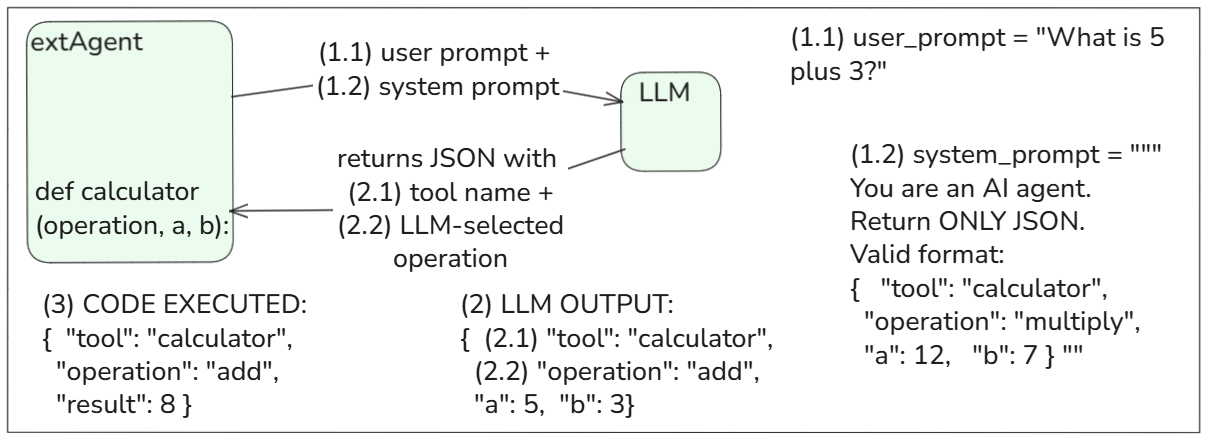
1b.1 py script
# ai_demo_01b_tool_openai.py
# Basic OpenAI tool-calling style demo
import json
import os
from dotenv import load_dotenv
from openai import OpenAI

# -----------------------------------
# Load API key
# -----------------------------------

load_dotenv()
client = OpenAI(
    api_key=os.getenv("OPENAI_API_KEY")
)

# -----------------------------------
# Tool implementation
# -----------------------------------

def calculator(operation, a, b):
    if operation == "add":
        return a + b
    if operation == "subtract":
        return a - b
    if operation == "multiply":
        return a * b
    if operation == "divide":
        return a / b
    raise ValueError(f"Unknown operation: {operation}")

# -----------------------------------
# Prompt
# -----------------------------------

user_prompt = "What is 11 multiplied by 6?"

system_prompt = """
You are an AI agent.
Return ONLY JSON.
Valid format:
{
  "tool": "calculator",
  "operation": "multiply",
  "a": 12,
  "b": 7
}
"""

# -----------------------------------
# Call OpenAI (REAL LLM OUTPUT)
# -----------------------------------

response = client.chat.completions.create(
    model="gpt-4.1-mini",
    messages=[
        {"role": "system", "content": system_prompt},
        {"role": "user", "content": user_prompt}
    ],
    temperature=0
)
llm_output = response.choices[0].message.content
print("\nLLM OUTPUT:")
print(llm_output)

# -----------------------------------
# Parse JSON
# -----------------------------------

action = json.loads(llm_output)

# -----------------------------------
# External agent executes tool
# -----------------------------------

if action["tool"] == "calculator":

    result = calculator(
        action["operation"],
        action["a"],
        action["b"]
    )

    final_result = {
        "tool": action["tool"],
        "operation": action["operation"],
        "result": result
    }

    print("\nCODE EXECUTED:")
    print(json.dumps(final_result, indent=2))
1b.2 Test
system_prompt = """
You are an AI agent.
Return ONLY JSON.
Valid format:
{
  "tool": "calculator",
  "operation": "multiply",
  "a": 12,
  "b": 7
}
"""
user_prompt = “What is 11 multiplied by 6?”
python ai_demo_01b_tool_openai.py
LLM OUTPUT:
{
  "tool": "calculator",
  "operation": "multiply",
  "a": 11,
  "b": 6
}
CODE EXECUTED:
{
  "tool": "calculator",
  "operation": "multiply",
  "result": 66
}
user_prompt = “What is 5 plus 3?”
python ai_demo_01b_tool_openai.py
LLM OUTPUT:
{
  "tool": "calculator",
  "operation": "add",
  "a": 5,
  "b": 3
}
CODE EXECUTED:
{
  "tool": "calculator",
  "operation": "add",
  "result": 8
}
1b.3 MOST important TF/UFA capabilities are:
@8 Semantic interpretation / inference
The TF must understand: “What is 12 multiplied by 7?” That is semantic interpretation.
But it also understood “What is 5 plus 3?” with the same system prompt.
@7 Structured constrained output generation
The TF must generate: { “tool”: “calculator”, “operation”: “multiply”, “a”: 12, “b”: 7 } in valid machine-readable structure. That is constrained structured output generation.
1b.4 Weak/minor involvement
@1 Generalization
Minor involvement. The TF can handle: “What is 12 times 7?” “What is 12 multiplied by 7?” “Compute 12 x 7” without exact training matches.
@4 Human-language robustness
Minor involvement. Could tolerate: “wat is 12 tiemz 7”
1b.5 NOT really involved
These are mostly NOT important in Step 1:
- @2 contextual tracking
- @3 feature abstraction
- @5 ontology alignment
- @6 explanation synthesis
- @9 planning/workflow synthesis
because the demo is intentionally simple.
26.0521