3.4.5 RAG retrieval tool
← 3.4 Agentic TF semantic demos
5 RAG retrieval tool (BINGO)
VERY important insight
You are now seeing why modern RAG depends heavily on TF/UFA capabilities. Because the TF must:
- semantically interpret retrieved text
- integrate it with user question
- reason over combined context
- synthesize final answer
Without TF/UFA semantics: RAG is mostly just search. The TF is what makes the retrieved text meaningfully usable.
VERY important conceptual insight
Your RAG demo now demonstrates:
- external retrieval
- +
- TF/UFA semantic interpretation
And THAT is the key reason modern RAG became practical. The retrieval itself is old. The revolutionary part is: TF semantic understanding of retrieved context.
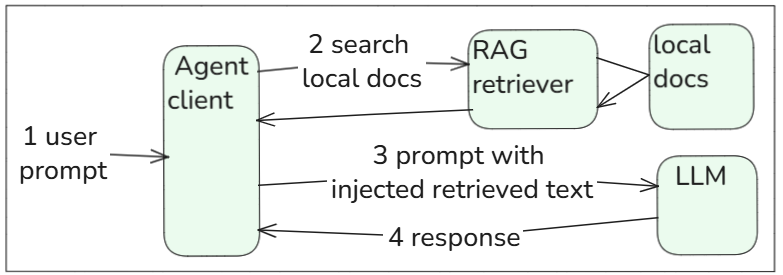
Expected idea: user question
- → Python retrieves relevant local docs
- → docs injected into prompt
- → LLM answers from retrieved context
- This is the core RAG pattern.
5.1 py script
# ai_demo_05_rag.py
# Basic RAG demo:
# retrieve relevant text
# inject retrieved text into LLM prompt
# LLM answers from retrieved context

import os
from pathlib import Path

from dotenv import load_dotenv
from openai import OpenAI

# -----------------------------------
# Load API key
# -----------------------------------

load_dotenv()
client = OpenAI(api_key=os.getenv("OPENAI_API_KEY"))

# -----------------------------------
# Demo documents
# -----------------------------------

DOCS_DIR = Path("rag_docs")
DOCS_DIR.mkdir(exist_ok=True)

(DOCS_DIR / "taipei_shipments.txt").write_text(
    "Truck 12 delayed in Taipei due to flooding. "
    "Truck 18 is on schedule in Taipei.",
    encoding="utf-8"
)

(DOCS_DIR / "supplier_notes.txt").write_text(
    "Supplier A reported an outage affecting brake components.",
    encoding="utf-8"
)

(DOCS_DIR / "weather_notes.txt").write_text(
    "Heavy rain caused flooding near Taipei logistics routes.",
    encoding="utf-8"
)

# -----------------------------------
# Simple retrieval tool
# -----------------------------------

def retrieve_docs(query, top_k=2):
    query_words = set(query.lower().split())
    scored_docs = []

    for path in DOCS_DIR.glob("*.txt"):
        text = path.read_text(encoding="utf-8")
        text_words = set(text.lower().split())

        score = len(query_words.intersection(text_words))

        scored_docs.append({
            "filename": path.name,
            "score": score,
            "text": text
        })

    scored_docs.sort(key=lambda x: x["score"], reverse=True)
    return scored_docs[:top_k]

# -----------------------------------
# User question
# -----------------------------------

user_question = "Why is Truck 12 delayed?"

# -----------------------------------
# RAG step 1: retrieve docs
# -----------------------------------

retrieved = retrieve_docs(user_question)

context = "\n\n".join(
    f"[{doc['filename']}]\n{doc['text']}"
    for doc in retrieved
)

print("\nRETRIEVED CONTEXT:")
print(context)

# -----------------------------------
# RAG step 2: inject context into prompt
# -----------------------------------

system_prompt = """
You are an AI assistant.

Answer the user question using ONLY the retrieved context.
If the answer is not in the context, say: "I do not know from the provided context."
"""

user_prompt = f"""
Retrieved context:

{context}

User question:
{user_question}
"""

response = client.chat.completions.create(
    model="gpt-4.1-mini",
    messages=[
        {"role": "system", "content": system_prompt},
        {"role": "user", "content": user_prompt}
    ],
    temperature=0
)

answer = response.choices[0].message.content

print("\nLLM ANSWER:")
print(answer)
5.2 Test
python ai_demo_05_rag.py
RETRIEVED CONTEXT:
[taipei_shipments.txt]
Truck 12 delayed in Taipei due to flooding. Truck 18 is on schedule in Taipei.

[supplier_notes.txt]
Supplier A reported an outage affecting brake components.

LLM ANSWER:
Truck 12 is delayed in Taipei due to flooding.
Content of 3 rag_docs
- Supplier A reported an outage affecting brake components.
- Truck 12 delayed in Taipei due to flooding. Truck 18 is on schedule in Taipei.
- Heavy rain caused flooding near Taipei logistics routes.
VERY important distinction
Your demo used:
- non-semantic retrieval
- +
- semantic TF interpretation
Modern advanced RAG often additionally uses:
- semantic embedding retrieval Meaning: documents are converted into:
- embedding vectors
query is converted into:
- embedding vector
Then:
- vector similarity search retrieves semantically related docs.
THAT is: vector RAG
But EVEN THEN: after retrieval, the retrieved text STILL usually gets: inserted into the prompt/context window for the TF to process semantically.
5.3 TF/UFA capabilites
Strongly involved
@1 Latent pattern generalization / approximation
VERY important. The TF can connect:
- “Why is Truck 12 delayed?” with retrieved text:
- “Truck 12 delayed in Taipei due to flooding” without rigid hardcoded rules.
@2 Contextual token dependency tracking
VERY important. The TF must maintain:
- user question
- retrieved documents
- instructions
- entity references inside one evolving context window. This is central to RAG.
@8 Semantic interpretation / inference
VERY important. The TF must:
- understand question meaning
- understand retrieved docs
- connect them semantically
- infer the answer. This is core RAG behavior.
@5 Semantic normalization / ontology alignment
Moderate involvement. The TF may connect: “delay” “late” “behind schedule” semantically. Very important in advanced RAG.
Moderately involved
@7 Structured constrained output generation
Moderately involved. The TF follows: “Answer ONLY using retrieved context.” This is a constrained semantic behavior. Would become even stronger if JSON outputs used.
@9 Hierarchical planning / workflow synthesis
Moderately involved. The overall RAG pipeline is: retrieve → inject context → answer Simple workflow orchestration. In advanced RAG this becomes much larger. Moderately involved
@6 Explanation/summarization synthesis
Moderately involved. The TF synthesizes:
- retrieved info
- semantic relationships into:
- final human-readable answer.
@4 Human-language robustness
Moderate involvement. The TF could still likely answer: “y truck 12 late?” despite noisy input. Weak/directly invisible
@3 Semantic feature abstraction
This underlies EVERYTHING internally. But:
- not directly visible in demo behavior
- more mechanistic/internal TF operation.
26.0521