ZiptieAI History
AI tech is evolving quickly. ZiptieAI is evolving along with it. What began as a drone-focused project has become an exploration of practical AI systems.
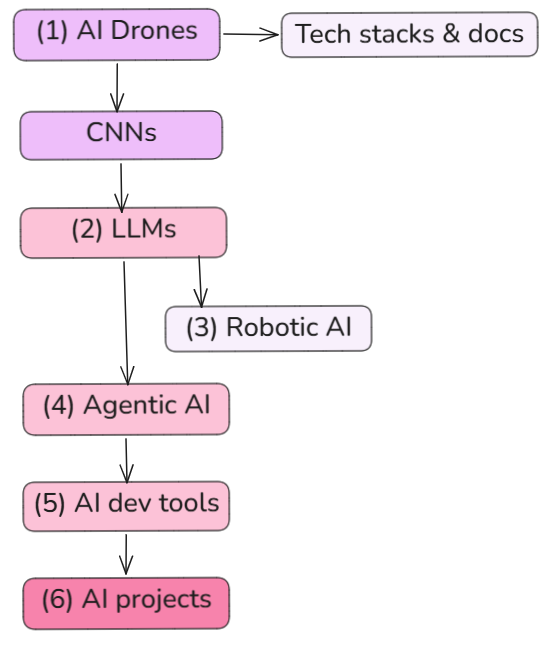
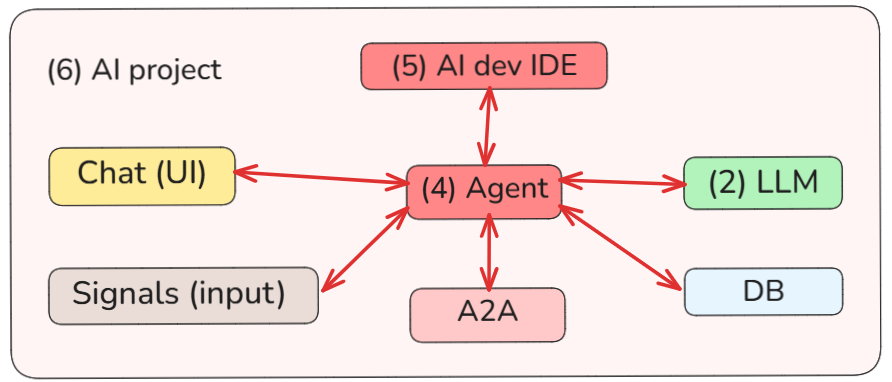
The first diagram (below left) shows the evolutionary stages and corresponding pages on this site. (2), (4), (5), and (6) are the main focus. The second diagram (below right) shows the (6) AI project components*.
(1) AI Drones
This was the first phase of ZiptieAI (the name was inspired by the zipties Ukraine used to quickly configure drones). This phase included drone flight simulation, hardware builds, AI, and flight tests (the first flight tests were in my kitchen). AI capabilities centered on:
- Object recognition using onboard cameras
- Autonomous flight support (AI-generated flight plan modifications)
My original plan was to spend the majority of my time on the drone AI (the drones were only meant to be carrier platforms). But I ended spending most of my time on building drones because of quality and usability issues with the open source software and components.
Tech Stacks & Docs
I documented my AI drone activities in detail. My original plan was to build my own ZiptieAI DIY drone website, wiki, and blogs (Substack and Youtube). The first step was a refresher course on the latest doc tools (MERN stacks and REST/GraphQL APIs/docs). For the first time I started using the latest AI tools for coding. I was amazed by how much these AI tools simplified development.
CNNs
CNNs (convoluted neural networks) were used for drone oject recognition. Studying CNNs was good preparation for studying the much more complex LLMs.
(2) LLMs
My focus shifted to LLMs (large language models)
- Transformers (the LLM neural network) (see the wiki page AI concepts for my explanation of GPT-3 transformer algorithms)
- API-based model usage (major frontier models)
- Local and remote model deployment (smaller models)
- Fine-tuning
- RAG, MCP, and tools
My goal was to understand the core concepts and how to build practical applications.
(3) Robotic AI
AI makes mistakes. For chatbots this is no big deal. But robots (especially those around humans, such as cars and humanoids) must not make mistakes. Yan LeCun’s claims that JEPA would provide real robotic intelligence intrigued me. So I did a lot of hands-on JEPA demos. I think what he is selling is not fundamentally different from LLMs. GPT agreed.
In any case, the time spent doing hands-on demos (for representational learning, prediction-based systems, belief tracking, control loops, planning under uncertainty, etc) was well spent. Many of the concepts (such as estimation and autonomy) were related to earlier drone work.
(4) Agentic AI
AI agents are the deterministic control loops (often written in Python) that are the core of AI applications. “Autonomous” AI agents perform complex tasks with limited (but critical) human intervention. My interest in AI is primarily in this area. I became particulary interested in Palantir’s AI systems because
- (1) they are very effective and
- (2) they can be used for a vast array of non-military purposes (logistics, manufacturing, healthcare, defense, operations, business intelligence)
There were claims that Palantir’s systems could become the real world SkyNet (see my substack post #73 Understanding Palantir Maven / Why AI will never become Skynet). But Palantir’s systems are assisted by AI, not controlled by AI. AI is simply a “helpful assistant”. AI does not press any buttons. The core control loop is traditional non-AI deterministic programming. AI is used for
- Input and output (of “messy” human language representations)
- Task planning (breaking up complex human language tasks into smaller deterministic tasks)
- Rule injection (by AI into the main loop)
Agentic AI (with it’s helpful AI assistants) will be one of the fastest-growing segments of AI in the future. The success of Palantir shows that such systems are already viable AI applications.
(5) AI dev tools
The goal of this section is to demo
- AI dev tools/IDEs (Codex, Cursor, etc) and
- related plugins (like the Render plugin for Codex)
(6) AI projects
After learning the AI dev tools and plugins you can “spin up” quickly complex projects. The goal of this section is to create demos of real-world AI projects that were spun up fast.
26.0428