Concepts -- 2.3 Training (NN)
This page describes how training works (for NN). Based on the xxx (demo xxx) (training).
training
# 3. Loss + optimizer
loss_fn = nn.CrossEntropyLoss()
optimizer = torch.optim.Adam(model.parameters(), lr=0.01)

# 4. Train
for epoch in range(1000):
#for epoch in range(100):
    logits = model(X)
    loss = loss_fn(logits, Y)

    optimizer.zero_grad()
    loss.backward()
    optimizer.step()
Training demo D2ccc overview
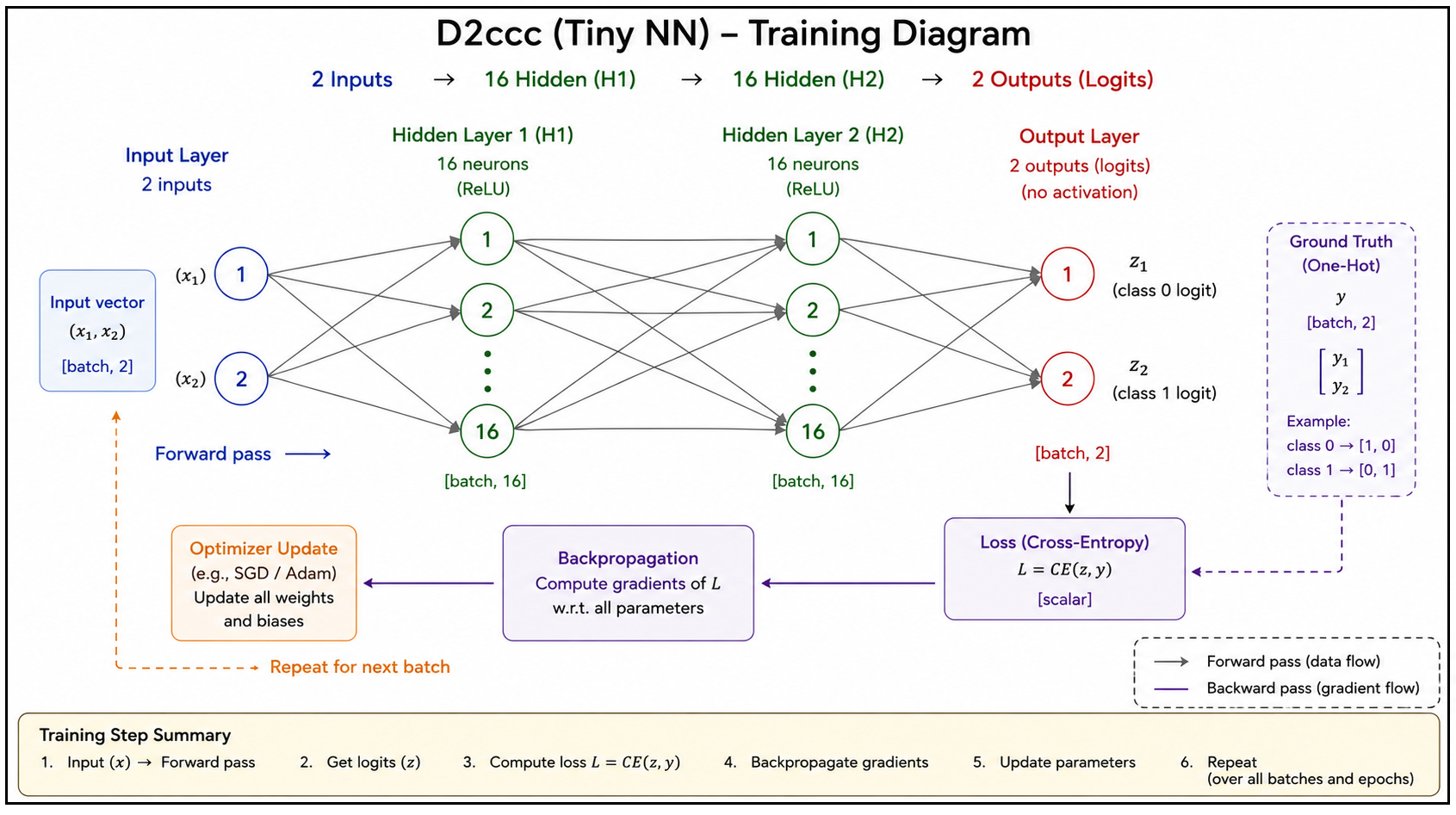
(why need more memory during inference).

Inference

During inference you only need:

weights
+
current activations
input
 ↓
forward pass
 ↓
output

Once a layer is finished, much of the intermediate data can be discarded.

Memory roughly:

model weights
+
a few activations
Training

Training must do:

forward pass
 ↓
loss
 ↓
backpropagation
 ↓
optimizer update

The expensive part is backpropagation.

During the forward pass, PyTorch stores lots of intermediate values:

layer1 output
layer2 output
layer3 output
...

because later it needs them to compute gradients.

So memory becomes:

weights
+
activations
+
gradients
Then the optimizer

For SGD:

weight
gradient

Not too bad.

For Adam:

weight
gradient
moving average
moving variance

roughly:

3-4x parameter memory
Your idea about "remembering the past"

You're partially right.

Adam does remember some history:

past gradients

which helps determine:

how much to change each weight

But it is not remembering concepts like:

cat
dog
digit 3

or trying to protect occupied weights.

That problem is called:

catastrophic forgetting

and ordinary SGD/Adam do not really solve it.

For a large LLM

A rough mental model:

Inference:
    weights

Training:
    weights
    + activations
    + gradients
    + optimizer state

which is why a model that fits on:

8 GB

for inference might require:

40-80+ GB

for training.

For your tiny demos the difference is invisible, but for GPT-sized models it becomes enormous. The biggest memory consumer is usually saved activations for backprop, not the optimizer history.
26.0623 (v1 26.0623)