C0 -- Minimizing AI risks (in the enterprise)
(WIP)
TOC
For now this is just a collection of thoughts/comments.. I will gradually refine and reorg.
- 1 Palantir protects enterprises from AI companies that steal secrets via prompts?
- 2 Demo D8 shows how to train model and deploy in PAL / do D2+D8 (RAG + MODEL)
- 3 Test PAL usage restrictions
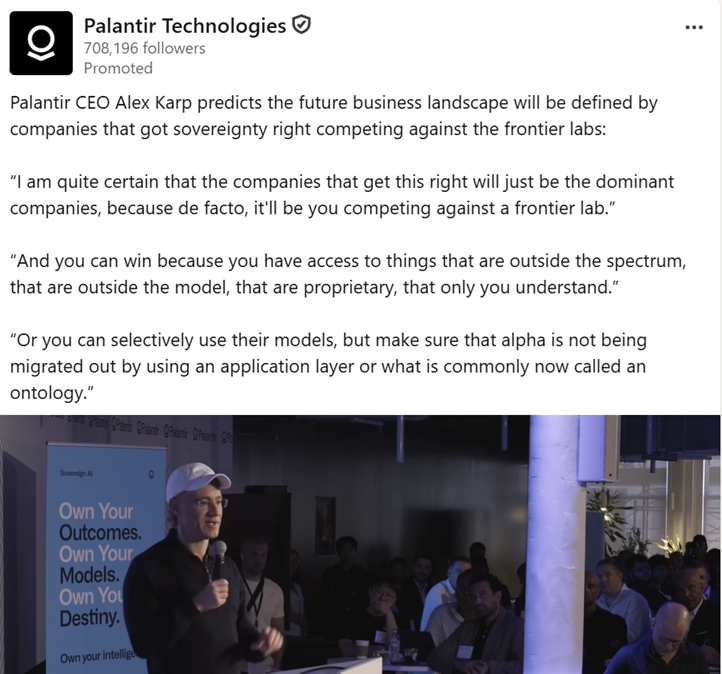
- 4 Alex Karp / secrets / RAG (chat with FDE)
1 Palantir protects enterprises from AI companies that steal secrets via prompts?
Foundry manages access to all aspects of AI. But you are still using external AI, so you are still sending data to AI companies (but thats much better than if employees had uncontrolled access). If you really want to keep your data safe, you’d use local models (with RAG, which is demo’d in this demo). This is of course the case… what interesting is those interviewing Alex dont ask that or ask for him to explain just how Palantir protects data. I dont show this in demo 2 yet, but thats in my near term future plans… I will work on that part with GPT/FDE (AI assistants) directly.
2 Demo D8 shows how to train model and deploy in PAL / combine with D2
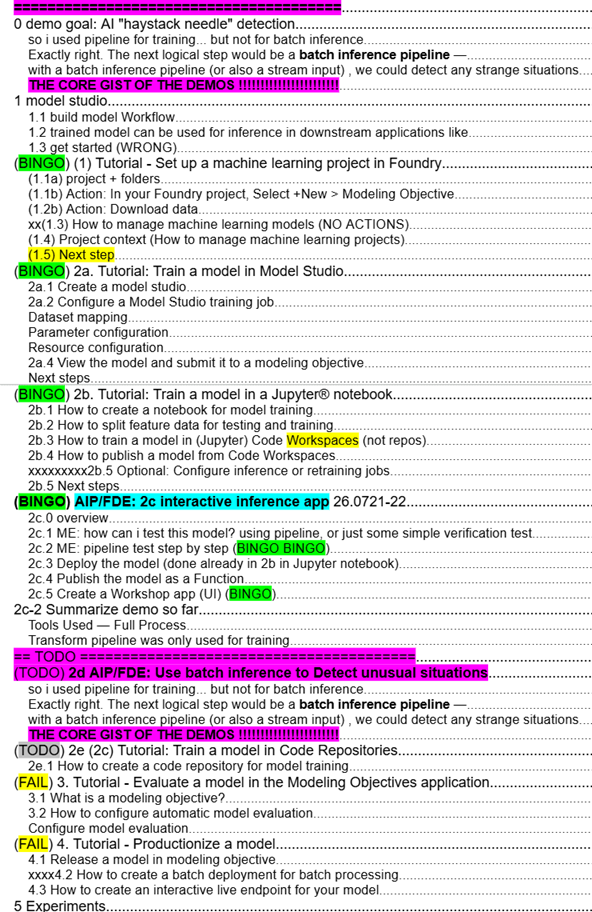
There is a ZAI version of demo D8 (creating a local model), but I ran into issues during deployment. I need to redo that demo, and then combine D2 and D8. I had limited success with this demo. I think PAL works fine, but the demo docx (as usual) were definitely lacking something.
But the real demo you need to do what Alex is talking about (“sovereignty”) is a combo of
- D2 (shows how do do RAG with model server (openAI, etc))
- D8 (shows how to train/deploy model in your PAL system)
NOTE: This also solves the problem of how frontier models can change dramatically in their programming/training. I recently started using GPT Sol 5.6, and when discussing the concept of an “internal agent” (an agent inside an model that handles all the functionality besides the transformer input classification), 5.6 was refusing to accept this idea. It took a long time to get 5.6 to accept this concept (my own). Every new version of a model means a new slightly different viewpoint on the world.
3 Test PAL usage restrictions
I still have not tried any demos for Foundry restrictions on employee activity. That to me is what would control the leaking of sensitive data to an external LLM. Foundry would use AI to scan any prompts going out of the enterprise.
4 Alex Karp / secrets / RAG (chat with FDE)
4.1 Alex Karp has recently been talking about how enterprises are giving the AI LLMs their secrets.
The impression people are getting is that somehow FOundry (and other PAL tools) will avoid this. but it does not. it only reduces the risk. we are still using remote models.
ME: Does Foundry keep enterprise secrets away from remote models?
FDE: Your interpretation is correct: not automatically.
When your AIP Logic calls GPT-4o, the question and retrieved reference text are transmitted to a third-party-hosted model endpoint for inference. Foundry therefore does not make remote inference equivalent to keeping data entirely inside the enterprise boundary.
What Palantir claims is that, for AIP-provided third-party models:
- Prompts and completions are not retained by the provider.
- They are not used to train the provider’s models.
- Provider personnel do not have access to them.
- Palantir obtains technical and contractual guarantees for those conditions.
AIP security and privacy / Do third-party-hosted model service providers have access to the data in AIP’s prompts?
Foundry additionally reduces risk by controlling:
- Which users and agents may access information
- Exactly what context is retrieved and transmitted
- Markings, roles, and purpose-based controls
- Model access and network egress
- Auditing and lineage
- Which actions an AI may execute
- Human approval around consequential operations
So the more accurate claim is:
- Foundry provides governed, controlled use of external models—not an absolute guarantee that data is never externally processed.
- For stricter sovereignty requirements, AIP can also self-host open-source or custom models inside the organization’s infrastructure, including on-premises or air-gapped deployments.
- Self-host models with AIP https://www.palantir.com/docs/foundry/aip/self-host-models#selfhost-models-with-aip
4.2 Foundry can help to train models (?) , but
still these will not be major frontier models. or will they in the future be good enough models for some specific apps? is this what Karp was talking about?
ME: Can Foundry train useful private models?
FDE: Yes, but there are several different categories.
1 Traditional enterprise models. Foundry can train and deploy models for:
- Classification
- Regression
- Forecasting
- Anomaly detection and similar specialized tasks
- Custom pro-code ML workloads
Model Studio directly supports common classification, regression, and time-series workflows . These models can be excellent for a specific organization because they learn its particular equipment, customers, operations, risks, or processes. They do not need to be frontier-sized.
2 Domain-specific language models. An organization can also:
- Import or register an existing model
- Fine-tune an open-source model
- Self-host it
- Connect an externally hosted model
- Use different models for different tasks
Foundry provides versioning, permissions, lineage, evaluation, deployment, and Ontology integration around such models. Externally hosted integrations are explicitly governed through model connections and egress policies. See Integrate an externally hosted model / Additional considerations for language models.
3 Frontier models. Training a new GPT-class frontier foundation model from scratch is generally outside the realistic scope of an individual enterprise. It requires extraordinary quantities of compute, data, research, and infrastructure.
But an enterprise often does not need its own frontier model. A smaller private model can be good enough for narrow tasks such as:
- Extracting known fields
- Classifying documents
- Routing cases
- Detecting operational anomalies
- Generating constrained reports
- Interacting with a limited set of tools
- Answering questions over a specialized corpus
RAG also means organizational knowledge does not have to be learned into the model’s weights. A model can receive the necessary governed context at runtime.
Likely strategic point. Without the exact Karp quotation, I would not claim his precise intent. But Palantir’s documented architecture emphasizes something broader than “we will train every customer a private frontier LLM”:
Use the best appropriate model—remote frontier, externally hosted, fine-tuned, or self-hosted—but place it inside a governed operational system that controls its context, permissions, actions, evaluation, and audit trail.
A practical enterprise architecture could therefore be:
- Small local models: sensitive, repetitive, narrow tasks
- Traditional custom ML: predictions and forecasts
- Remote frontier models: difficult reasoning where policy permits
- Foundry/Ontology: context, security, orchestration, auditing, and operational actions
That reduces exposure and dependence on remote frontier models, but it does not eliminate them unless the organization deliberately chooses a fully self-hosted architecture.
4.3 TF is just a classifier
ME: you wrote “RAG also means organizational knowledge does not have to be learned into the model’s weights.
A model can receive the necessary governed context at runtime.”**
The TF is (in my opinion) stricctly a classifier.
- It classifies the input (prompt + running response) which is converted to a token and added to the running response.
- why general models must be so big is that they also are trained not only on grammar, sentence structures, document sturctures, etc, they also contain a lot of info about specific topics (“what is the capital of france”).
The internal agent is procedural code that
- controls flow
- knows how to interact with the TF to get the job done.
for RAG we dont need the specific topic truth… we supply it. so for a local model to do RAG, what are the minimal capabilities for the model? they are much less than for frontier model. it must have an internal agent + TF that can handle
- language capabilities (grammar, vocab, etc)
- able to handle the meaning of the prompt and RAG input
FDE: Your model is largely correct, with one important distinction between the transformer and the agent/orchestrator.
Transformer as next-token classifier. An autoregressive transformer repeatedly:
- Receives the prompt plus tokens generated so far.
- Computes a probability distribution over its vocabulary.
- Selects a next token.
- Appends that token and repeats.
In that mathematical sense, it is repeatedly performing classification over possible next tokens. Calling it only a classifier can understate the computation occurring inside the network, but the basic description is correct. Large general models contain both:
- General language and document patterns
- A substantial amount of factual and conceptual information learned during training
Scaling also improves reasoning, instruction-following, robustness, and in-context learning—not merely factual storage.
(I DISAGREE WITH THE FOLLOWING…. HAD A LONG CHAT WITH GPT-5.6 Sol AND EVENTUALLY GOT IT TO AGREE WITH MY TERMINOLOGY)
The agent is normally external. A transformer does not ordinarily contain an internal procedural agent that controls program flow. Its forward-pass structure is fixed. The agent or orchestrator is usually external software that:
- Decides when to call the model
- Retrieves information
- Builds prompts
- Invokes tools
- Validates results
- Repeats steps when necessary
In this Foundry demo, AIP Logic is the external orchestrator:
Question → embedding search → retrieve chunks → format reference text → call GPT‑4o → return answer
GPT-4o does not perform retrieval and does not control this workflow. It performs the final context-based completion.
Minimum local model for simple RAG. A local answering model does not need:
- Broad authoritative knowledge of every domain
- Built-in retrieval
- An internal agent
- Embedding capabilities
- Tool calling
- Knowledge of the Ontology or Vertex
The embedding model and application code can remain separate. The answering model minimally needs:
- Language competence Grammar, vocabulary, syntax, and document structure.
- Instruction following Understand rules such as “answer only from the supplied references.”
- Reading comprehension Interpret the question and relevant passages, including references and terminology.
- Contextual synthesis Combine information from several retrieved passages into one answer.
- Grounded generation Preserve names, numbers, qualifications, and other details from the references.
- Abstention behavior Say that the supplied context is insufficient rather than inventing an answer.
- Adequate context length Fit the instructions, question, retrieved passages, and generated response.
For this demo, that is essentially all:
- Instructions + question + reference text ↓
- small instruction-tuned LLM ↓
- grounded answer
Topic knowledge is reduced, not entirely unnecessary. RAG shifts the burden of authoritative factual truth from model weights to retrieved context. That allows a much smaller model to perform well on a bounded application.
However, the model still needs enough conceptual understanding to interpret the context. A model that knows language but has no useful representation of medicine may struggle with phrases such as:
- Multidrug resistance
- Latent infection
- Treatment regimen
- Epidemiological burden
General language knowledge and domain knowledge are also entangled during training; they are not cleanly separable sections of the weights. A good local design might therefore use:
- A relatively small general instruction model
- Optional domain adaptation or fine-tuning
- A separate embedding model
- Deterministic orchestration code
- Retrieved enterprise context
- Output validation and citations
Three levels of complexity
| Application | Necessary model capability |
|---|---|
| Search and display documents | No generative model required |
| Simple retrieve-then-answer RAG | Compact instruction-following model |
| Agentic, multi-step RAG | Stronger model with planning/tool-use capabilities |
This Foundry demo is fundamentally the middle case. It does not inherently require a frontier model. GPT-4o provides greater quality and robustness, but a smaller self-hosted model could be entirely adequate if it passes tests for faithfulness, comprehension, abstention, latency, and domain terminology.
26.0826 (v1 26.0825)